
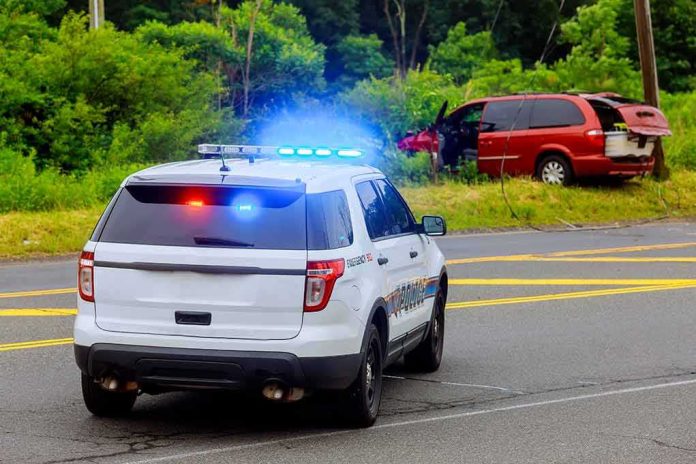
When automated license-plate readers move from “investigative lead” to de facto identification, human beings become collateral to a statistical shortcut; the Lindsey Isaacs case shows how that slippage can end with an innocent driver in solitary confinement.
At a Glance
- An ALPR hit on a black Dodge Durango became part of a fatal-crash investigation, culminating in Lindsey Isaacs’s arrest and 13 days in jail, including 86 hours in isolation.
- Witnesses had described a maroon Durango with a partial plate “458,” yet investigators focused on Isaacs’s black Durango seen 2–3 miles from the scene.
- Photographs later showed no collision damage to Isaacs’s vehicle; prosecutors dropped her case and charged another driver.
- Flock Safety says its cameras produce leads, not guilt determinations, and that the data placed Isaacs’s car near—but not at—the crash site.
What the Isaacs case establishes, and what it does not
Start with the uncontested spine of the record. In sworn Senate testimony, Isaacs stated that a Flock camera record became part of the investigation that led to her arrest on three counts of vehicular homicide and 13 days in jail, including approximately 86 hours of continuous lockdown in a suicide-prevention smock. Multiple outlets reported the same core sequence: a Flock capture of her black Durango within a few miles of the crash corridor, a focus on her vehicle despite witness references to a maroon Durango and a partial plate “458,” and—months later—the decision to drop her case while pursuing another suspect. Those events are not speculation; they are now embedded in a Senate hearing record and matched by contemporaneous coverage.
What this record does not finally answer is the narrow technical failure mode. We do not have the full probable-cause affidavit, the ALPR hit confidence score, or the precise logic investigators used to weigh an alert against contradictory descriptors. That evidentiary gap matters for diagnosing the error pathway—was it a misread plate, an overbroad query, or confirmation bias applied to a lead that should have been treated as tentative? But the chain of consequence is plain: the automated hit migrated from a clue to a central accelerant of suspicion, and the downstream process did not successfully filter it out before an arrest was made and a jail term served.
How ALPRs work—and where errors creep in
Modern ALPR systems photograph passing vehicles, extract plate characters and vehicle attributes (make, model, color), and index each scan by time and location for later search. Properly used, that index can corroborate a timeline, test an alibi, or surface investigative leads. The danger is categorical: a “hit” is a hypothesis generator, not an identification. Errors arise from at least four layers—optical/algorithmic misreads, stale or incorrect hot lists, human overreach in search parameters (e.g., partial plates), and cognitive bias once a candidate plate appears to “fit.” Policy research and field audits have repeatedly found nontrivial error and mis-hit rates, reinforcing the professional norm that an ALPR alert demands independent verification before it grounds detention or arrest.
In the Isaacs matter, witnesses reportedly described a maroon Durango with a partial plate, while the system logged a black Durango near the vicinity. That is precisely the scenario that calls for friction in the pipeline—confirming color, validating physical damage, reconstructing time and distance rigorously—before translating a data point into probable cause. The record indicates that much of that verification failed or came too late, evidenced by the later photographic contradiction of alleged vehicle damage and the eventual prosecutorial pivot to a different suspect.
Flock Safety’s position, weighed against the record
Flock Safety’s response cleaves to a defensible general principle: their cameras generate leads; they neither determine guilt nor make arrests. The company also points to the placement of Isaacs’s vehicle several miles from the crash, minutes beforehand—information they characterize as exculpatory because it does not tie the car to the impact site itself. On its face, that framing is consistent with how ALPR should be used: as context, not conclusion.
But the company’s general defense does not negate the case’s material outcome. Isaacs was arrested and jailed, and her testimony, corroborated by multiple reports, is that the Flock record became part of the investigative core that led there. If the data were truly exculpatory in practice, they did not function that way inside the investigative workflow that mattered. The operational lesson is not that ALPR is incapable of aiding a case; it is that absent disciplined verification and guardrails, a lead’s aura of objectivity can eclipse better, contradictory evidence.
Conditions of confinement are not a footnote
Isaacs’s account of jail conditions—approximately 86 hours in near-continuous lockdown in a suicide-prevention garment, followed by transfer to a mental health unit and then a maximum-security housing unit—belongs at the center of any serious risk assessment of surveillance-enabled error. Pretrial detention is not an administrative inconvenience; it is punishment without conviction, and the carceral system will subject the mistakenly accused to the same protocols as the guilty. That reality amplifies the duty of care on the front end to ensure that a probabilistic alert never becomes the sole ladder to incarceration.
Where the real fix lives: policy, process, and proof standards
Good policy distinguishes between alert and action. Sensible safeguards are not exotic: require contemporaneous corroboration—visual confirmation of plate and unique vehicle features, damage consistent with the alleged offense, and a documented time-distance feasibility check—before any ALPR hit contributes to probable cause. Treat color mismatches and partial-plate reliance as red flags that elevate the verification threshold, not as trivial discrepancies to explain away. Set retention limits and access logging so that post hoc review can reconstruct who searched what, when, and why; that auditability disciplines behavior in real time.
Equally important is courtroom rigor. If a state’s case leans on an ALPR trail, disclosure of the underlying image, read confidence, query parameters, and hot-list provenance should be the rule, not the exception. That technical transparency is the only way a defense can probe whether the alert was reliable, the search overbroad, or the conclusion preordained. In Isaacs’s case, prosecutors ultimately declined to pursue her and instead charged another driver—an institutional admission that, whatever the initial theory, the totality of evidence did not hold together.
🚨NEW: False Automated License Plate Recognition Lead Triggers Nightmare Arrest and Solitary Confinement for Innocent Florida Driver
FULL LAWSUIT 👇🏽 https://t.co/8zkemAgGRf
A Florida woman has delivered harrowing testimony detailing her wrongful arrest and brutal mistreatment… pic.twitter.com/iVGn1l9P63
— Amy Leigh (@IAmyLeigh) September 24, 2026
The broader pattern—and a disciplined way forward
Isaacs’s ordeal tracks a growing pattern documented by legal and policy researchers: ALPRs can be valuable, but they fail conspicuously when an alert is treated as an end state instead of a starting point. Reviews catalog wrongful stops and arrests tied to misreads, stale lists, and unverified hits; experts therefore urge agencies to codify verification steps and narrow data use, rather than abandon the technology outright. That is the adult posture here. The right question is not whether machines should read plates—it is whether institutions will bind their own discretion so a “lead” cannot skip the line to handcuffs.
Sources:
lifesitenews.com, lawcommentary.com, judiciary.senate.gov, wftv.com, fox13news.com, cnn.com, cbs12.com, yahoo.com, iapp.org, foxnews.com