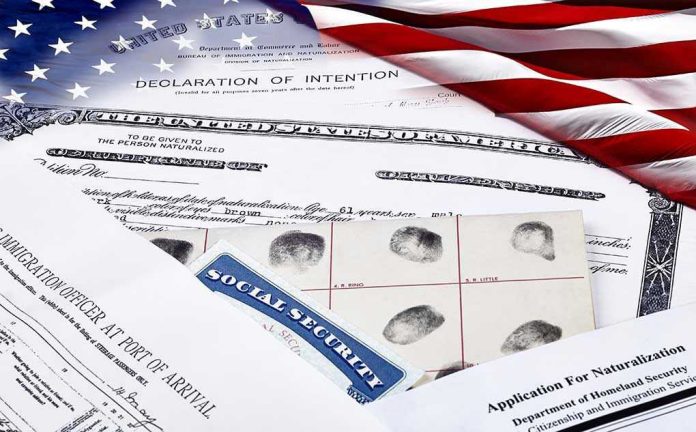
Washington’s latest green-card rule is drawing fire because it pushes many legal immigrants out of the country just to finish a process they once could pursue from inside the United States.
Quick Take
- The Department of Homeland Security says most applicants now must use consular processing outside the United States.[1]
- U.S. Citizenship and Immigration Services says the change is meant to restore the law’s intended operation and reduce loopholes.[1][2]
- The agency still says approval remains discretionary and can be granted in extraordinary circumstances.[1][2]
- Reporting says the move has already created confusion for applicants and employers.[1][4]
What the New Guidance Changes
The Trump administration announced that many temporary visa holders seeking permanent residence must now leave the country and apply through consular processing abroad.[1] That marks a major shift from the familiar in-country adjustment process, which the federal government itself still describes as a lawful path for eligible nonimmigrants. The policy is not framed as an outright ban on green cards, but as a narrower and more restrictive channel for obtaining them.[1][2]
According to U.S. Citizenship and Immigration Services, the goal is to stop what officials describe as loopholes and to make the immigration system “function as the law intended.”[1][2] Quarles reports that officers are told to review cases individually and may still approve applications in extraordinary circumstances.[1] That means the agency is asserting discretion, not abolishing adjustment of status altogether, even as it steers most applicants toward overseas processing.[1][2]
Why Supporters Say the Shift Is Legal
The strongest defense of the policy is that adjustment of status has always been discretionary, not guaranteed.[2] Carnegie Mellon University’s summary of the guidance says Form I-485 approval is discretionary and “not intended to supersede the regular consular processing of immigrant visas.”[2] EIG Law also describes the memo as a reminder that adjustment is a matter of “discretion and administrative grace,” language that matches the administration’s argument that it is restoring proper enforcement rather than rewriting the statute.[3]
Supporters also point to the agency’s claim that the change will free up resources for other immigration priorities.[1] Quarles reports USCIS said the new approach would redirect staff time toward cases involving crime victims, trafficking victims, and naturalization applications.[1] For readers frustrated with years of open-border chaos, that rationale will sound familiar: the government is saying it wants to tighten a benefit that has been treated too loosely while shifting attention to cases officials consider more urgent.[1][2]
Why Critics See a Serious Disruption
Critics say the rule still changes the practical meaning of green-card access because it forces many lawful applicants to leave the United States and process abroad.[1] USA.gov continues to say a nonimmigrant in the United States may be able to stay and apply for adjustment of status. NBC News reported that the new requirement would force people here on temporary visas to return to their home countries, and that contrast is fueling the backlash.[1]
Is it the whole “if ur waiting for a green card, you must wait in your own country and not allowed to stay in the US”
I wasn’t sure if that affects them but it’s the only thing that comes to mind rn that I’ve seen it can be about
— SJC (@zivalagresac) May 27, 2026
The available record also shows important unanswered questions. The sources provided do not include the full legal memo, the detailed criteria for “extraordinary circumstances,” or the internal instructions that will guide adjudicators.[1][2][3] That matters because vague exceptions can create inconsistent outcomes, and any policy that affects large numbers of families, workers, and employers needs clear standards if it is going to survive legal and political scrutiny.[1][2][3]
What Happens Next
The immediate fight will likely center on litigation, implementation, and whether the administration can defend the change as a lawful exercise of discretion rather than a rule-like overhaul.[1][2][3] The reporting already suggests confusion is spreading among applicants who expected to remain in the country while their cases moved forward.[1][4] If courts step in, the policy could be narrowed, delayed, or tied up for months, which would only deepen the uncertainty for people trying to follow the rules the right way.[1][2][3]
Sources:
[1] YouTube – Green card application process now forces immigrants to return home | …
[2] Web – Top 5 Things to Know about the New USCIS Adjustment of Status …
[3] Web – USCIS Policy Guidance on Adjustment of Status
[4] Web – USCIS Issues Policy Memo Requiring Adjustment of Status …