
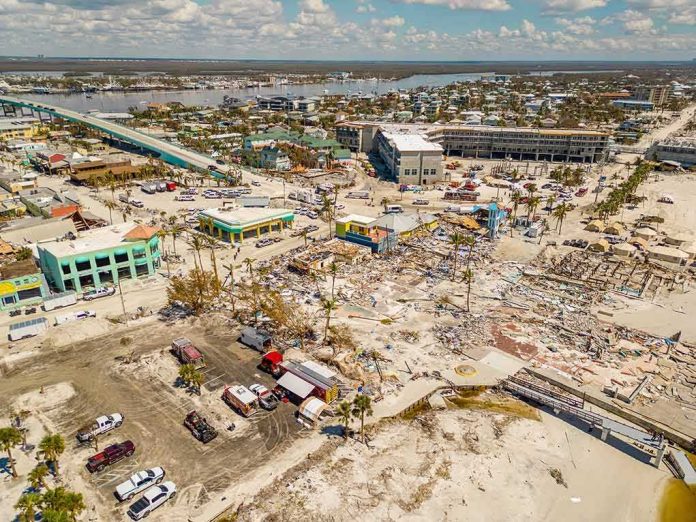
A massive 7.8 magnitude earthquake has struck the southern Philippines, collapsing buildings, triggering tsunami warnings across three nations, and killing dozens — a catastrophic natural disaster demanding urgent attention from Americans with ties to the region and a stake in Pacific stability.
Story Highlights
- A magnitude 7.8 earthquake struck offshore of Sarangani, Mindanao at 7:37 a.m. local time on June 8, 2026, confirmed by the Philippine Institute of Volcanology and Seismology (PHIVOLCS) and the U.S. Embassy in Manila.
- At least 32 people were killed and more than 200 injured, with casualty counts continuing to rise as rescue operations expand across affected provinces.
- Tsunami warnings were issued for nine Philippine provinces, as well as coastal areas in Indonesia and Japan, prompting mass evacuations.
- Buildings collapsed in General Santos City, including a fast food restaurant and a school, with video footage documenting widespread structural damage.
A Major Quake Rocks Southern Mindanao
The Philippine Institute of Volcanology and Seismology (PHIVOLCS) recorded the magnitude 7.8 earthquake at 7:37 a.m. on June 8, 2026, with the epicenter located approximately 32 kilometers south of Sarangani in the southern Philippines. The U.S. Embassy in Manila issued an immediate natural disaster alert confirming the event’s location at coordinates 05.57°N, 124.98°E, classifying it as an offshore strike capable of generating destructive tsunami waves along nearby coastlines.
The quake registered intensity 7 shaking in General Santos City, one of the most populated urban centers in the region. Early reports noted significant structural damage across the city, with residents fleeing buildings as tremors rolled through the area. Philippine President Bongbong Marcos ordered the suspension of classes at all levels across affected Mindanao provinces as a precautionary measure, and the Department of Education quickly followed with a formal announcement covering all of southern Mindanao.
Buildings Down, Casualties Rising
Video footage from General Santos City showed collapsed structures, including a fast food restaurant and a school with severe structural damage. General Santos City police confirmed at least one death and four injuries within city limits, while the South Cotabato Provincial Disaster Risk Reduction and Management Office reported two additional deaths in Barangay Cablon in the town of Tupi — bringing the early confirmed total to three fatalities. Later reporting from ABC News placed the death toll at a minimum of 32, with more than 200 people injured as rescue operations reached more remote communities.
Early wire reports initially stated no confirmed fatalities as local officials were still conducting damage assessments, illustrating how rapidly the situation evolved. Some initial media reports cited a magnitude of 7.1 from one agency while others referenced 7.8 from Germany’s GFZ geosciences center, though PHIVOLCS and the U.S. Embassy alert both confirmed the 7.8 figure. Such discrepancies are common in the first hours following a major seismic event, as different agencies use different measurement methodologies before a consensus figure is established.
Tsunami Warnings Span Three Nations
PHIVOLCS issued tsunami warnings covering nine provinces: Sarangani, Davao Occidental, Tawi-Tawi, Sulu, Basilan, Zamboanga del Sur, Zamboanga Sibugay, Sultan Kudarat, and South Cotabato. Waves measuring up to 1.4 meters were recorded in six coastal areas by 11:00 a.m. local time, prompting evacuations of low-lying coastal communities. Tsunami monitoring agencies in Indonesia and Japan also activated warnings, reflecting the regional hazard posed by an offshore event of this magnitude in the seismically active western Pacific.
The @IFRC and the Philippine Red Cross @philredcross are responding to a powerful 7.8-magnitude earthquake that struck off the coast of Maasim, Sarangani, Mindanao, on 8 June 2026.
📸Philippine Red Cross @philredcross pic.twitter.com/9UFwFFn6KG
— IFRC (@ifrc) June 8, 2026
The Philippines sits along the Pacific Ring of Fire and has a long history of devastating seismic events. The 1976 Moro Gulf earthquake, which also struck near Mindanao, remains one of the deadliest in Philippine history. Monday’s earthquake serves as a stark reminder of the ongoing geological threat facing millions of Filipinos living in the southern archipelago, and underscores the importance of robust early-warning systems and international disaster response coordination. The International Federation of Red Cross and Red Crescent Societies and the Philippine Red Cross both mobilized rapidly to assist affected communities as the full scope of damage continued to emerge.
Sources:
[1] YouTube – 7.8 earthquake rocked Philippines’ Mindanao Island.
[2] YouTube – 15 Dead As 7.8 Magnitude Quake Hits Mindanao, Tsunami …
[3] YouTube – Magnitude 7.8 quake hits Philippines, at least 32 killed
[4] Web – Natural Disaster Alert: Magnitude 7.8 Earthquake, Tsunami …
[5] Web – A 7.8 magnitude quake in Philippines kills at least 32, sets off …
[6] Web – 1976 Moro Gulf earthquake – Wikipedia