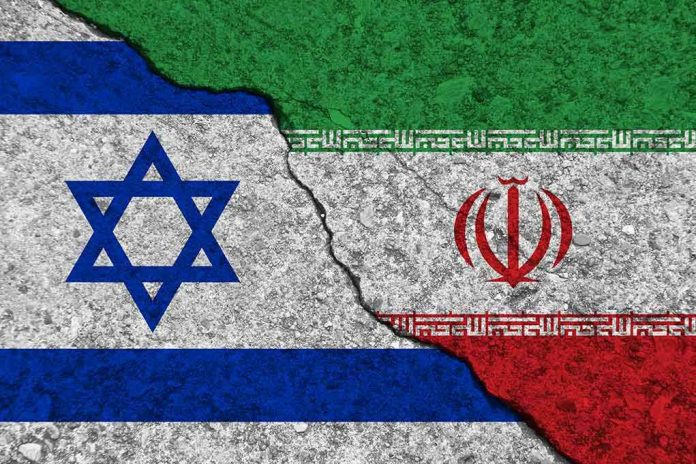
The Twelve-Day Iran–Israel War of June 2025 has brought the Middle East to a boiling point, threatening regional stability.
Story Snapshot
- Iran emerges as Israel’s primary existential threat with its “Axis of Resistance” network.
- The direct military confrontation between Iran and Israel culminated in the Twelve-Day War of June 2025.
- The United States intervened, targeting Iranian nuclear facilities on June 21, 2025.
- Ongoing unrest in Iran raises concerns about further escalation.
Iran’s Strategic Shift: From Proxy Warfare to Direct Confrontation
Iran has long been a shadow adversary to Israel, but recent developments have elevated it to Israel’s primary existential threat. Through its nuclear program, ballistic missile arsenal, and network of proxy militias, Iran has created a formidable “Axis of Resistance” that directly challenges Israel’s security. This shift culminated in the Twelve-Day Iran–Israel War of June 2025, marking a significant escalation from proxy warfare to direct state-on-state conflict.
The war began with Israel launching large-scale air and missile strikes on Iranian nuclear and military targets. In retaliation, Iran responded with ballistic missile barrages targeting Israeli cities and infrastructure. The United States entered the fray on June 21, 2025, launching strikes on Iranian nuclear facilities at Natanz, Isfahan, and Fordow. This intervention underscored the strategic importance of Iran’s nuclear ambitions and the perceived threat they pose to regional stability.
Regional Consequences and Strategic Implications
The aftermath of the Twelve-Day War has left the region in a precarious balance. Israel and the United States claim to have severely degraded Iran’s nuclear and missile capabilities. However, Iran’s regional proxy activity has intensified, complicating the geopolitical landscape. The unrest within Iran, exacerbated by economic hardships and political grievances, further destabilizes the situation and raises the specter of renewed conflict.
Iran’s strategic posture is driven by its desire to deter Israeli and U.S. attacks while expanding its regional influence. This ambition is manifested through its support for Hezbollah in Lebanon, Hamas in Gaza, and other proxy groups across the Middle East. These entities form a crucial part of Iran’s “Axis of Resistance,” which poses a persistent threat to Israel’s security and regional peace.
The Role of the United States and Future Prospects
As Israel’s primary security ally, the United States plays a pivotal role in countering Iran’s influence in the region. The U.S. military’s involvement in the June 2025 war demonstrated its commitment to maintaining regional stability and preventing nuclear proliferation. However, the potential for a larger, multi-theater conflict remains a significant concern.
Moving forward, the balance of power in the Middle East will be shaped by the ongoing dynamics between Israel, Iran, and their respective allies. The possibility of further U.S. intervention, coupled with Israel’s willingness to take preemptive action, suggests that the current ceasefire is tenuous at best. As tensions simmer, the region remains on the brink of a broader confrontation that could have far-reaching implications for global security.
Sources:
Timeline of the Iran-Israel War
The Road to the Israel-Iran War
U.S.-Iran Confrontation Analysis
Unrest in Iran: Context and Implications