
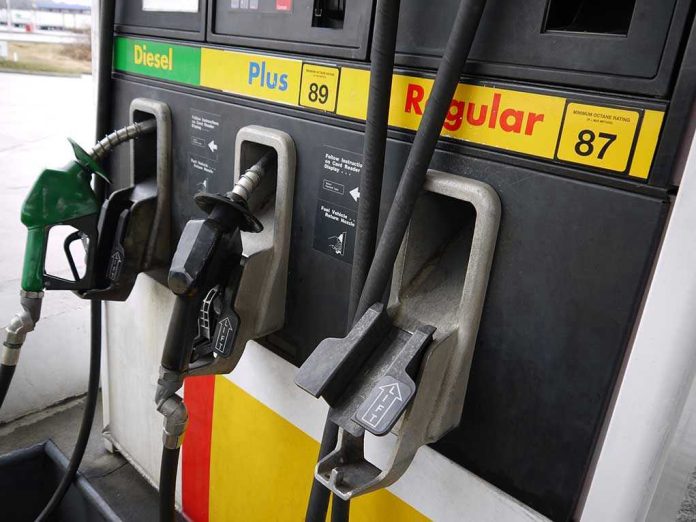
With gas prices spiking from a war half a world away, President Trump is betting that a temporary federal gas-tax holiday can deliver fast relief—if Congress can agree on how to pay for it.
Quick Take
- President Trump said he wants to suspend the federal gasoline tax “for a period of time” as the Iran war continues to pressure oil markets.
- The federal gas tax is 18.4 cents per gallon for gasoline and 24.4 cents per gallon for diesel, and suspending it would require congressional action.
- AAA reported a national average gas price of about $4.52 per gallon on May 11, up sharply since the war began on Feb. 28.
- Republicans Sen. Josh Hawley and Rep. Anna Paulina Luna said they plan to introduce bills, while Democrats argue they floated similar ideas earlier.
- Budget math is the main obstacle: reports estimate a federal revenue hit of roughly $500 million per week, threatening Highway Trust Fund financing.
Trump’s proposal targets war-driven pain at the pump
President Donald Trump told CBS News in a May 11 phone interview that he intends to suspend the federal gasoline tax temporarily as Americans absorb higher fuel costs tied to the Iran war. Trump framed the idea as short-term relief, saying the tax would be phased back in once prices come down. The announcement landed as the conflict entered roughly its 11th week and the Strait of Hormuz disruption continued to roil global supply.
AAA data cited in coverage put the national average at about $4.52 per gallon on May 11, with some areas—especially California—seeing prices above $6. Those numbers matter politically because fuel costs are one of the most visible “everyday inflation” line items for working families, retirees, and small businesses. Even voters who don’t follow foreign policy closely feel the impact immediately when commuting, running errands, or paying higher delivery and service fees.
Congress must act, and the math is not small
Suspending the federal levy is not something a president can do alone. The gas tax—18.4 cents per gallon for gasoline and 24.4 cents for diesel—flows into the Highway Trust Fund and supports federal transportation spending. Reports estimate that a suspension would reduce federal revenue by roughly $500 million per week. That cost forces lawmakers to decide whether to backfill the trust fund, cut spending, or accept deeper deficits.
Supporters argue that cutting a tax tied directly to daily life respects limited-government instincts by easing a burden rather than creating a new program. Critics counter that the relief is modest relative to a $4.52 gallon, potentially dropping the average price by around 18 cents—about a 4% dip—while leaving the underlying supply shock untouched. The real price driver remains the conflict’s effect on oil flows and market expectations, not the tax line on a receipt.
Bipartisan interest meets a familiar credit fight
Republicans quickly moved to translate Trump’s signal into legislation. Sen. Josh Hawley and Rep. Anna Paulina Luna said they plan to introduce bills to suspend the tax. Democrats, meanwhile, pointed out that they had already introduced proposals in recent weeks to pause or reduce the levy. That creates a familiar Washington dynamic: both sides can support the same consumer-friendly idea while fighting over who gets credit—and whether the final bill includes broader measures.
The internal GOP debate may be as important as the partisan one. Fiscal hawks generally resist temporary “holidays” that drain dedicated funding streams without firm offsets, especially when voters already distrust Washington budgeting. At the same time, retail gas prices are a kitchen-table issue that can overwhelm process arguments. For leaders, the test is whether they can deliver quick, understandable relief without repeating the spending patterns that many Americans blame for years of stubborn inflation.
What the gas-tax push suggests about the war’s timeline
Some analysts read the proposal as an implicit acknowledgement that the Iran war’s economic fallout may not fade quickly. Coverage noted that ceasefire talks appear shaky, and Trump publicly criticized Iran’s latest proposal. If the Strait of Hormuz disruption persists, Americans could face elevated fuel costs for longer than a news cycle—making near-term policy moves more urgent. That also raises a strategic question: how to balance household relief with sustained funding for roads, bridges, and freight corridors.
President Trump announcing plans to move toward suspending the federal gasoline tax as the Iran war continues to drive up energy costs pic.twitter.com/zUOvBUWVGk
— Tamara Keith (@TamaraKeith01) May 12, 2026
For most families, the immediate question is simple: will it pass, and will it show up at the pump? Even if Congress approves a suspension, implementation details—start date, duration, and how refiners and stations pass savings through—will shape what drivers actually see. For lawmakers, the bigger question is whether Washington can address a clear problem without turning it into another deficit-funded gesture, especially as war pressures and distrust of “business as usual” government continue to rise.
Sources:
Trump says he aims to suspend gas tax ‘for a period of time’
What Trump’s Gas Tax Plan Says About the War With Iran
Iran war ceasefire grows increasingly shaky after Trump rejects Tehran’s latest proposal
Trump wants to suspend the federal gas tax as prices soar amid war with Iran