Pete Hegseth walked into a rain-soaked West Point stadium and announced, in effect, that the era of the “woke military” was over—and that these cadets were the ones expected to prove it.
Story Snapshot
- Hegseth used West Point’s commencement to declare war on diversity, equity, and inclusion ideology inside the armed forces.[2][3][5]
- He tied the rollback of diversity programs to a renewed emphasis on merit, unity, and combat readiness.[2][3]
- Supporters see a needed course correction; critics say he offered rhetoric, not hard evidence, for a “woke” decline.[2][3][5]
- The clash over his speech previews the larger fight over what kind of culture will define America’s officer corps.[1][2]
How A Rainy West Point Stage Became Ground Zero In The Culture War
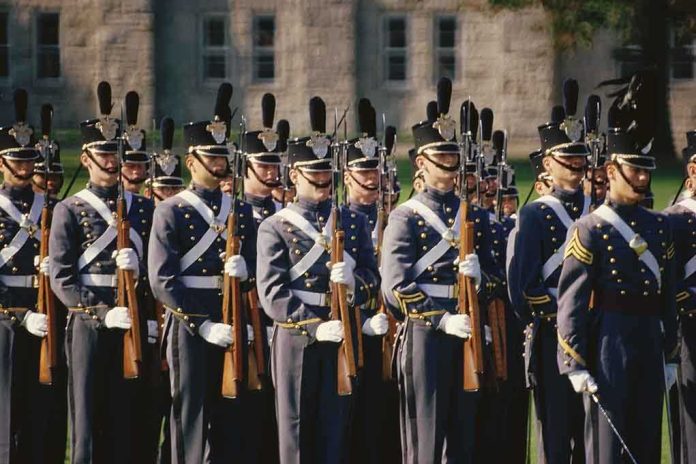
West Point graduations usually showcase military precision and patriotic boilerplate; this one turned into an ideological line in the sand. Standing in the rain before nearly a thousand new second lieutenants, Defense Secretary Pete Hegseth blasted past leaders he said had tried to turn West Point into “woke Princeton,” loading the academy with diversity programs and professors who pushed anti-American ideas.[2][3][5] He told the cadets that era ended on their watch and under their command.
Hegseth’s language sounded less like a standard secretary speech and more like a manifesto. He rejected the idea that “diversity is our strength,” flipping the popular slogan by insisting that unity, not demographic bean-counting, makes a fighting force lethal.[5] He linked diversity, equity, and inclusion initiatives with a “slow slide” in the Army, warning that identity politics creates factions where what matters most is not your rifle skill or field judgment, but which box you check on a personnel form.[3][5]
The Policy Shift Behind The Rhetoric
The speech did not come out of nowhere; it rode on an already moving policy train. Months earlier, Hegseth directed the Department of Defense to bar sex-, race-, and ethnicity-based targets in admissions and hiring at West Point, the Naval Academy, and the Air Force Academy.[2] His memo ordered the elimination of diversity, equity, and inclusion offices and programming and banned classroom instruction on critical race theory, diversity ideology, and gender ideology across the academies.[2]
Hegseth framed these moves as a return to color-blind meritocracy—one standard, applied equally, with no promises of equal outcomes.[2][3] That message dovetailed with President Donald Trump’s broader push, which included ordering full reviews of academy leadership, curriculum, and training to root out diversity bureaucracies and political litmus tests.[1] Hegseth’s West Point appearance, then, functioned as the public, emotional rollout of a bureaucratic housecleaning that had already begun inside the Pentagon.
Does “Woke” Really Weaken A Military, Or Just Its Reputation?
Critics of Hegseth’s speech concede his passion but question his proof. News coverage and transcripts quote him accusing prior leaders of importing anti-American ideologies and weakening the academy, yet they do not present inspector general reports, readiness audits, or performance data that tie diversity programs to measurable military decline.[2][3][5] On the available record, the link between “we hired diversity staff” and “the Army got weaker” remains an assertion, not a documented causal chain.
That gap matters because the United States military has weathered earlier cultural shifts—from racial integration to the inclusion of women and gay service members—while remaining the country’s most trusted institution. Social science research generally finds that unit cohesion hinges more on training, leadership, and mission clarity than on demographic sameness, which suggests diversity and readiness need not be enemies. Still, when Pentagon messaging sounds more like a campus faculty meeting than a war plan, many Americans instinctively worry that priorities have drifted.
Why Hegseth’s Message Resonates With Many Americans
For a large swath of the country, Hegseth’s speech did not sound extreme; it sounded overdue. Parents sending their kids into uniform want generals focused on beating enemies, not chasing equity metrics. Taxpayers expect the Pentagon to buy shells and ships before it buys consultants and training modules about “unconscious bias.” Hegseth tapped that sentiment by promising a culture that rewards initiative, toughness, and merit, while openly mocking what he called the “dumbest phrases in military history.”[3][5]
Pete Hegseth delivers a dose of the facts as he rips into a "woke military" and DEI during his West Point commencement speech:
"The battlefield does not grade on a curve, and you can't throw your pronouns at the enemy. Combat is the ultimate test, and our best Americans must ace… pic.twitter.com/bMHO0XSKXT
— Julia 🇺🇸 (@Jules31415) May 23, 2026
From a common-sense conservative perspective, his core argument tracks: the military should be ruthlessly apolitical, color-blind, and obsessed with winning wars. Where his case is weakest is not in the values he names but in the evidence he offers for how far the Army had actually fallen. If “woke” ideology truly damaged readiness, the Pentagon should show its homework—metrics, not just moods. Until then, Hegseth’s West Point moment will function less as a verdict on the past than as a marching order for the future.
Sources:
[1] Web – Trump addresses West Point graduates following DEI crackdown at …
[2] Web – Hegseth rants about ‘woke military’ during fiery West Point …
[3] Web – US Army hits 2026 recruiting goals four months early, Pete Hegseth …
[5] Web – Hegseth rants about ‘woke military’ during fiery West Point …