
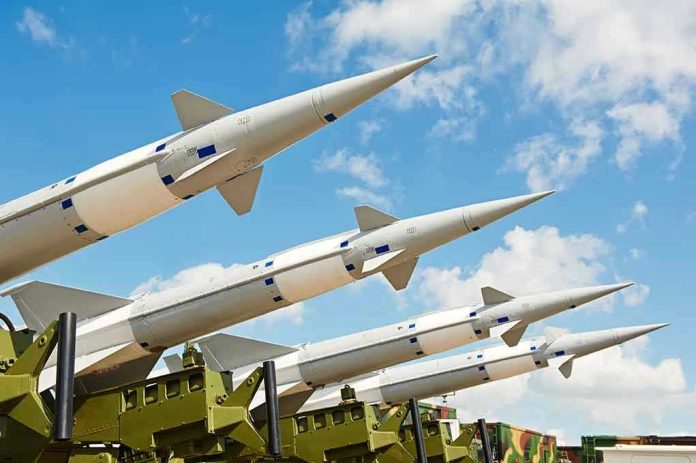
U.S. officials now suspect Iran used a Chinese-made shoulder-fired missile to down an American F-15E over southwestern Iran—an alarming sign of Beijing’s gear bolstering Tehran’s trigger finger against U.S. forces [1].
Story Highlights
- U.S. investigators reportedly judge a Chinese-made man-portable missile as the likely weapon in the F-15E shootdown [1].
- Reports say Chinese radar technology may have strengthened Iran’s ability to track advanced U.S. jets [2].
- Public evidence remains limited; officials’ assessments use cautious “likely” language pending full confirmation [1].
- The incident underscores risks from Chinese-Iranian defense ties and the need to harden U.S. air operations [3].
Officials’ Assessment Points To A Chinese-Made Missile
U.S. officials and sources familiar with the investigation reportedly concluded the F-15E Strike Eagle was likely hit by a Chinese-made shoulder-fired missile while operating over southwestern Iran, according to reporting summarized by multiple outlets [1]. The accounts describe a man-portable air defense system as the most probable weapon used, consistent with the altitude and profile of the incident as understood by investigators [6]. The careful wording—“likely” rather than confirmed—signals confidence without revealing classified sources or methods publicly [1].
Media summaries trace the core claim to U.S. official assessments, not to Iranian announcements or anonymous social media conjecture [1]. Additional reporting relays that Chinese-supplied technology could have aided Iranian forces, but stops short of naming a specific missile model or displaying recovered fragments in the public domain [2]. That restraint matches common early-stage incident reporting in conflict zones, where attribution often leans on intelligence indicators while debris analysis and formal after-action reports remain undisclosed [3].
Chinese Radar Support Allegations And Air-Defense Implications
Separate reports add that Beijing-linked radar provided Iran with improved ability to detect and track advanced aircraft, potentially tightening the kill chain against U.S. fighters [2]. Some outlets specifically reference radar systems described as capable of detecting low-observable or difficult-to-track targets, a capability that would complicate U.S. mission planning and escape windows during ingress and egress [3]. If accurate, that pairing—better tracking plus a shoulder-fired weapon—illustrates how incremental foreign assistance can sharpen Iran’s layered air-defense picture [2].
For U.S. aircrews, a threat envelope that combines surveillance upgrades with ubiquitous shoulder-fired missiles compresses tactical margins. Pilots depend on terrain masking, electronic warfare, and countermeasures to break acquisition and defeat launches. Enhanced early warning can cue shooters sooner, shrinking survivability buffers and stressing defensive tactics. These dynamics argue for refreshed suppression-of-air-defenses packages, tighter route discipline, and tailored countermeasure programs to blunt proliferating sensors and missiles in contested airspace [2].
Evidence Thresholds, Cautionary Language, And What We Still Do Not Know
While the reporting is consistent that officials assess a Chinese-made shoulder-fired system as the likely culprit, none of the public pieces provides open-source imagery of missile debris, a serial number trail, or a formal government after-action report [1]. The repeated use of careful qualifiers—“likely,” “may have,” “unclear whether operational”—fits the pattern of early intelligence-driven briefings where corroborating material is classified or pending [1]. That does not invalidate the assessment; it frames it as preliminary, awaiting further forensic confirmation [3].
US officials believe a Chinese-made shoulder-fired missile was used by Iranian forces to bring down an F-15E warplane.
Report via The Cradle.
— Capital Digest (@CaptialDigest) June 1, 2026
Iran has not publicly confirmed using a Chinese-made missile, and Tehran has offered no detailed technical rebuttal addressing the specific allegation reported by U.S.-linked sources [1]. In this gap, responsible analysis distinguishes between plausible attribution and proven fact. For readers, that means acknowledging the weight of official assessments while demanding verifiable details as investigations mature. Prudence favors preparing U.S. forces as if the threat is real, even as final attribution proceeds through disciplined evidence standards [2].
Strategic Stakes For U.S. Policy And Readiness
If a Chinese-origin shoulder-fired missile downed a U.S. F-15E, the incident highlights a growing China-Iran defense pipeline that undermines American pilots’ safety and regional deterrence [1]. Conservative priorities—peace through strength, secure borders, and a military second to none—require rapid countermeasures: surge electronic warfare kits, refine infrared countermeasures, harden mission planning against improved radar, and tighten sanctions and interdictions to disrupt transfers that empower regimes hostile to the United States and its allies [2].
The Trump administration’s obligation is clear: protect our service members, reassert deterrence, and hold enablers of aggression to account. That means aligning intelligence, diplomacy, export-control enforcement, and military posture to deny Iran the ability to stitch together foreign sensors and missiles into lethal ambushes. Congress should back urgent funding for survivability upgrades and demand transparency on the investigation’s findings so families, taxpayers, and warfighters know exactly what happened and how America will respond [3].
Sources:
[1] Web – US Officials Suspect Iran Used Chinese Missile To Bring Down F-15E …
[2] Web – Chinese-made shoulder-fired missile reportedly shot down F-15 …
[3] Web – Chinese Missile Likely Downed US F-15 Fighter Jet In Iran: Report
[6] YouTube – How Chinese Tech Downed a US F-15 Strike Eagle!