
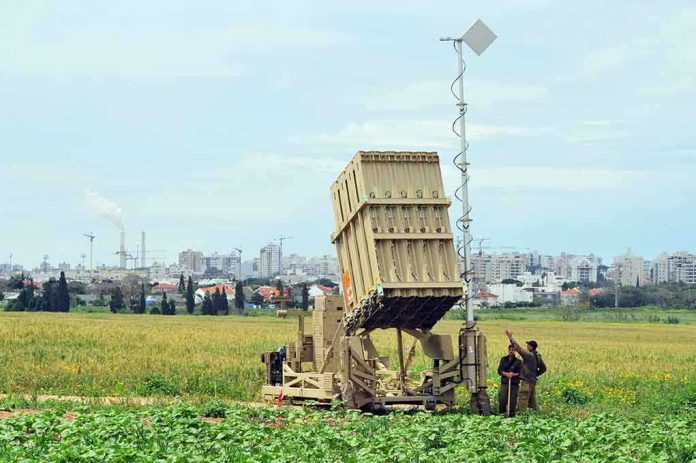
Iranian missiles streaked toward Jordan, but air defenses lit the night sky and shot them down, raising fresh alarms about a widening war and American troops in harm’s way.
Story Snapshot
- Jordan’s military says it intercepted missiles launched from Iran over its territory [1][2].
- Reports agree on intercepts but differ on the exact number of missiles [1][2][3][4].
- Jordan reported no injuries in one account; another clip shows debris damage [1][7].
- Conflicting early numbers reflect fast-moving wartime reporting [1][2][3][4].
Jordan Reports Intercepts Over Its Territory
Jordan’s armed forces said they intercepted missiles launched from Iran over central-eastern Jordan. Gulf News reported the army stated it shot down 20 missiles and that debris caused no injuries or damage [1]. The Times of Israel relayed a Jordanian statement about five missiles shot down near the al-Azraq area [2]. Caspian Post summarized claims that 13 ballistic missiles were intercepted [3]. Despite the different counts, all reports align on a core fact: Jordan engaged incoming threats in its own airspace.
Jordan’s military described post-strike steps that fit a real intercept. Officials said engineering teams moved to debris sites to check for explosive materials and secure remnants [1]. That detail matches standard air-defense practice. It points to more than rumors or online clips. It suggests a coordinated response with trained teams, safety checks, and local control. These steps help limit panic, protect civilians, and preserve evidence that could confirm what flew and where it came from.
Conflicting Counts Show Fog Of War, Not Fiction
Different outlets listed five, 13, or 20 missiles. Some social posts spoke of larger salvos. This mix reflects the first hours of a crisis, when numbers shift as militaries and reporters sort data [1][2][3][4]. The overlap still matters. Each source says Jordan’s air defenses fired and hit targets overhead. That pattern points to a real event with uncertain totals, not a false alarm. Early tallies often change after logs, radar tracks, and debris analysis come out.
Reports also conflict on damage. Gulf News cited no injuries or losses from falling debris [1]. A short video report said debris hit a home and caused a fire [7]. Both can be true in part. Intercepts can spread fragments. Most land harmlessly; a few cause small fires or broken roofs. Without a full, public damage survey, these pieces will not match cleanly. That is why militaries collect fragments and check sites. Final answers often come days later, not minutes after the blasts.
Why This Matters For Americans And Allies
Iran firing missiles that cross toward a United States partner is a red flag for our forces and our friends. Jordan sits on a front line of regional security. When Jordan’s air defenses go to work, it signals that the threat is not far from United States troops and bases. Conservative readers know this pattern. Weakness invites more testing. Strength, clarity, and coordination save lives and stop a slide toward a wider war. Intercepts over Jordan show both risk and resolve.
The United States under President Trump’s second term must keep deterrence strong and rules simple. Do not let Iran push lines. Back partners who block hostile fire. Share accurate facts fast, and expose lies. Demand full incident logs when safe to release them. That includes radar tracks, intercept records, and careful debris reviews. Jordan’s own statement mentioned engineers on the ground [1]. Publishing vetted findings can settle counts and types and confirm launch origin.
What We Know, What We Do Not
We know Jordan’s armed forces reported intercepts of missiles launched from Iran. We know the number is unclear, with credible outlets citing five, 13, or 20. We know one outlet reported no injuries, while a short clip suggested debris damage [1][2][3][7]. We do not have the full original text of the Jordanian military communiqué in this package. We do not have public radar tracks, chain-of-custody debris photos, or a final damage map. Those limits cap certainty today.
🇮🇷 The First Order Consequence:
Iran’s reported action of firing more than 30 missiles at Jordan risks accelerating regional military risk for Iran by escalating direct cross-border retaliation potential and reducing diplomatic leverage, including amid uncertainty about the… https://t.co/9siSneaD4u— U.S.A.I. 🇺🇸 (@researchUSAI) June 11, 2026
Practical steps can close the gaps fast. Jordan can release its full statement and an incident timeline. Allied sensors can confirm tracks without giving up sensitive sources. Local authorities can publish a brief damage and injury log. Independent labs can examine fragments to identify missile types. Each step builds trust and reduces noise. Until then, the most solid line stands: Jordan fired at incoming missiles and knocked them down over its territory [1][2][3][4].
Bottom Line For Readers
Iran tested a key United States partner, and that partner answered with working air defenses. The facts on exact counts will settle later, as they always do in war reporting. What matters now is resolve. Keep pressure on Tehran’s aggression. Support allies who defend their skies. Demand proof and transparency, not spin. That is how we protect American troops, uphold order, and stop a wider fight from landing on our doorstep.
Sources:
[1] Web – Jordan’s military says intercepted 20 missiles launched from Iran
[2] Web – Jordan intercepts 20 missiles launched from Iran , no injuries …
[3] Web – Jordan says it intercepted five Iranian missiles, reports no injuries …
[4] Web – Jordan’s Air Defense Intercepts 13 Iranian Ballistic Missiles
[7] Web – Jordan Intercepts Iranian Missiles Over Its Airspace … – Facebook