
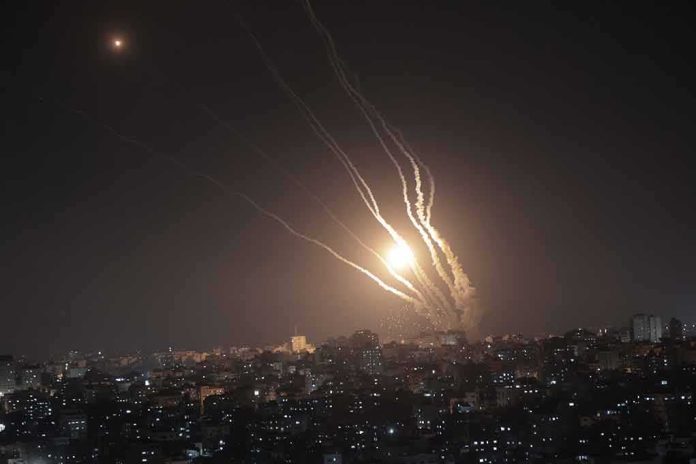
A massive overnight Russian strike firing 70 missiles and 611 drones at Ukraine is raising fresh questions about Europe’s security choices and what they mean for American taxpayers and energy prices.
Story Snapshot
- Ukraine says Russia launched 70 missiles and 611 drones in one of the war’s largest night attacks.
- Historic churches and apartment blocks burned as civilians were killed and power lines went down.[1][5][8]
- European dependence on Russian-style energy and weak defense left the continent exposed, again.[1]
- Trump’s push for fair burden-sharing and strong borders looks more urgent as war grinds on.[1]
Russia’s Overnight Barrage Shows How Big the War Has Become
Ukrainian military officials say Russian forces fired 70 missiles and 611 drones across the country overnight, calling it one of the largest air attacks of the war.[1][3] According to Ukraine’s Air Force, air defenses shot down 50 of the 70 missiles and 582 of the 611 drones, based on early data.[1][3] Even with those intercepts, dozens of weapons still hit their targets, which included big cities like Kyiv, Kharkiv, Dnipro, and Sumy.[1][5]
Reports from the ground describe thick smoke over Kyiv and other cities as fires burned after the strikes.[5] Several tall apartment buildings were hit, cars went up in flames, and at least four to nine people were reported killed, with many more hurt, depending on the outlet.[1][5][8] Ukrainian sources say the attack knocked out power for about 140,000 people around Kyiv when energy sites were damaged.[1] These numbers may shift as officials check damage and hospitals update casualty lists.[1]
Historic Churches and Civilian Sites Hit While Moscow Claims “Military Targets”
Among the most shocking images from the night were flames at the Kyiv Pechersk Lavra monastery complex, a symbol of Ukraine’s Christian heritage going back centuries.[5][8] German outlet Deutsche Welle reports that the historic cathedral grounds in Kyiv ended up on fire after the barrage.[8] Ukrainian officials say residential areas were also struck, with casualties reported in Kyiv and Kharkiv regions during the same wave of attacks.[1][2] These scenes add fuel to long-running claims that Russia is hitting civilian sites.[8]
Russian officials often insist they only target military or infrastructure facilities, but the pattern of burned homes and damaged churches tells a different story to many observers.[5][8] At least nine people were reported dead across several regions, including rescue workers killed while responding to earlier strikes in Kharkiv.[1][8] The fog of war means exact numbers change, yet the clear picture is blunt: ordinary families, not just soldiers, are paying the price when hundreds of drones and missiles rain down in one night.[1][5][8]
What This Means for Europe’s Security and America’s Wallet
This attack follows a familiar wartime pattern, where the side under fire releases early counts and foreign media repeat them before full audits are done.[1][3][7] Here, Ukrainian announcements drive the narrative, and nearly every outlet cites their figures on launch totals and intercepts.[1][3][5][8] There is no Russian Ministry of Defense data in these reports that directly challenges the 70 missiles and 611 drones claim, so most of what the world sees is the Ukrainian version.[1][7] That matters when Washington debates aid, sanctions, and military stockpiles.
The Security Service of Ukraine has shown fragments of the Geran-2 drone Russia used to strike the Kyiv-Pechersk Lavra.
Russia lied that the fire was caused by a Patriot air defence missile. pic.twitter.com/Fr7MqPNyUn
— Maria Drutska 🇺🇦 (@maria_drutska) June 15, 2026
For American readers, the deeper issue is how Europe’s past choices helped create this fragile security picture. European governments leaned on cheap energy tied to Moscow for years, while underfunding defense and counting on American taxpayers and troops to fill the gap.[1] Now Russia can launch one of the largest overnight attacks of the war, and Europe still struggles to supply air defenses and ammunition without U.S. help. That is exactly the burden-sharing problem Trump has hammered since his first term.
Energy Dependence, Open Borders, and the Cost of Endless Crises
Energy infrastructure again sits in the crosshairs as reports note damage to power networks around Kyiv, leaving many without electricity.[1] This is a warning shot for Western countries that moved away from reliable domestic production toward globalist green deals and foreign suppliers. When a hostile power can flip the switch off for hundreds of thousands overnight with drones, it exposes how dangerous overdependence on outside energy sources can be in a crisis.[1] Stable, homegrown energy becomes a national security issue, not only an economic one.
At the same time, the war feeds fresh waves of refugees and strains social systems across Europe, while the United States still battles its own border crisis. The same elites who cheered weak borders and massive spending packages now ask working Americans to bankroll yet another long conflict overseas. Conservatives can support Ukraine’s right to defend itself while also demanding clear goals, strict oversight, and real European skin in the game before writing more blank checks. That approach protects U.S. security, the dollar, and basic fairness for American families.
Why This Strike Underscores the Need for Strength, Not Wishful Thinking
The scale of this attack—hundreds of drones and dozens of missiles in one night—shows that Russia is not backing down, even as sanctions and battlefield losses stack up.[1][5][8] It also shows the power of cheap drone swarms, which any hostile regime could use against Western cities, power systems, or military bases if they see weakness. American conservatives who insist on strong missile defenses, secure borders, and a real industrial base are not being alarmist; they are reading the battlefield in front of them.
As Trump’s second-term team presses NATO partners to meet real defense targets and rethinks foreign entanglements, this strike is a reminder of what happens when globalist promises crash into hard reality. Historic churches burn, families huddle in dark basements, and the bill for decades of bad energy and security policy lands in the laps of ordinary people. The lesson is simple: peace comes from strength, secure borders, and leaders who put their own citizens first—before they chase applause in global forums.
Sources:
[1] Web – Russia launched 70 missiles, 611 drones at Ukraine overnight: …
[2] X – Taras Kachka
[3] Web – The Ukrainian military says Russia has launched 70 missiles and …
[5] Web – Russia launched one of its largest aerial attacks on Ukraine …
[7] Web – Orthodox leader calls Putin ‘Antichrist’ after airstrike on historic …
[8] Web – Russia strikes leave historic Kyiv cathedral in flames – DW