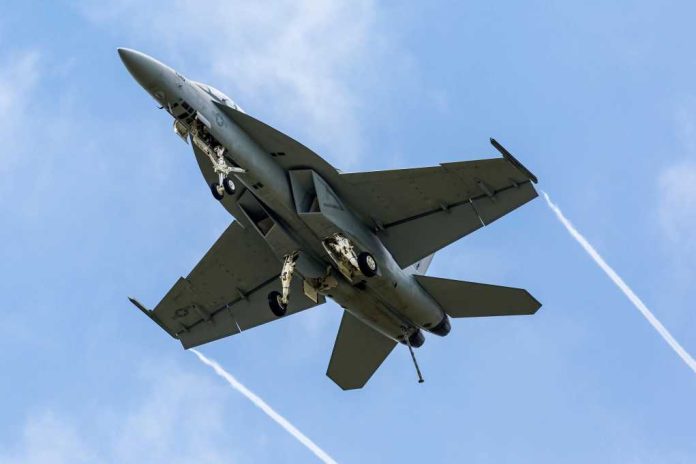
A new watchdog report warns that America’s aging refueling tankers are not ready for a major war, even as our enemies race ahead.
Story Snapshot
- A federal watchdog says U.S. Air Force tankers failed to meet readiness goals from 2019 through 2025.[1][3]
- Legacy KC-135 and new KC-46 tankers are both suffering from low mission capable rates and chronic parts problems.[1][2]
- Shortages of trained maintainers and poor access to technical data are dragging down repairs.[1][2]
- These failures weaken U.S. power projection just as great-power threats grow, after years of mismanagement.[2][3][6]
Watchdog Finds Years of Missed Readiness Targets
The Government Accountability Office, the main audit arm of Congress, reviewed the U.S. Air Force tanker fleet from fiscal year 2019 through 2025 and found that the aircraft did not meet the service’s own goals for availability and mission capable rates in any of those years.[1][2][3] The mission capable rate measures how many planes are ready to fly the missions they are supposed to perform. When those numbers stay low for years, it signals a deeper, systemic problem inside the force, not just a bad month or two.
The new report shows how serious the decline has become. In fiscal year 2024, the Eisenhower-era KC-135 tankers managed a mission capable rate of just under 68 percent, while the newer KC-46 tankers came in at only 62 percent.[1] That means roughly one out of three tankers was not ready to fully perform when needed. A National Defense Magazine summary noted that mission capability has “substantially” declined since 2019, underscoring that this is a steady slide, not a one-time dip.[3]
Old Planes, Broken Parts, and Thin Maintenance Ranks
Government Accountability Office auditors traced much of the readiness trouble to basic sustainment failures, especially spare parts.[1][2] Air Force officials told investigators there were “critical shortages” of key parts for both KC-135 and KC-46 aircraft, and maintainers across several units said parts failures were the main cause of low availability. In some cases, the original vendors that made parts for the 60-year-old KC-135 have gone out of business, leaving gaps in the supply chain that the defense industrial base struggles to fill.[1][2]
Even when parts exist, there are not enough skilled hands to install them. The report found shortages of experienced maintainers at both depots and front-line units, made worse by a shift from military to civilian workers who are still learning the job.[1][2] At some bases that fly both tanker types, staffing for maintainers is technically full, but about three-quarters of those workers lack the needed experience to handle complex repairs.[1] KC-46 program officials admitted that the Air Force did not plan well for the skilled people required to support the new aircraft once it entered service, a planning failure that now hits day-to-day readiness.[1]
Technical Data Gaps and Infrastructure Headaches
The Government Accountability Office interview with lead auditor Diana Maurer highlighted another hidden problem: technical data.[2] She explained that repair manuals and access to key intellectual property for both aircraft are not sufficient for uniformed personnel to fix the systems with confidence. Because the contractor-provided manuals do not always match real-world operating conditions, Air Force maintainers have been forced to create informal knowledge networks just to figure out how to keep the planes flying.[2] That kind of work-around culture is clever but not a stable way to run a critical fleet.
Physical infrastructure is also lagging. Maurer noted that the larger KC-46 has trouble fitting into older hangars that were never modernized for its size.[2] As a result, some aircraft are being left outside, exposed to weather that speeds wear and tear and complicates maintenance. All of these issues—missing parts, untrained maintainers, weak technical data, and poor hangar space—stack together and lengthen repair times. In a crisis, that drag on the system could mean fewer tankers available to support fighters, bombers, and mobility aircraft across the globe.
Air Force Promises Fixes, But Risks Remain High
Air Force leaders told the Government Accountability Office that they have “resolved the critical shortages” of tanker parts through better coordination with contractors and by reverse engineering some components.[1] They also point to plans that they say will boost KC-46 availability by about six percent in the near term and by more than twenty percent by 2030.[1] Acting acquisition officials have framed these steps as proof that the fleet will recover in time to meet future demands as older aircraft retire and more KC-46s enter service.[1][3]
Yet the auditors warn that these promises are not enough. Their core finding is that the tanker fleet has already failed to meet readiness standards for several straight years and that the Air Force still lacks focused sustainment metrics and a risk-based mitigation plan.[1][3][7] This matters for every American who cares about national defense. Aerial refueling is what allows U.S. aircraft to reach distant battlefields and stay there. As early as 2003, Congress and the Department of Defense were already worried about the age of the fleet and its impact on operations.[5] Two decades later, many of the same concerns remain, proving that paperwork fixes and upbeat talking points cannot replace real maintenance, robust training, and honest planning.
Sources:
[1] Web – U.S. Refueling Fleet Falls Below Air Force Readiness Standards
[2] Web – GAO: Air Force Tanker Fleet Struggling with Readiness
[3] YouTube – The Air Force’s Aerial Refueling Fleet Is Shrinking in Capability
[5] Web – Reprioritizing the US Air Refueling Fleet for Great-Power Conflict
[6] Web – Military Aircraft: Information on Air Force Aerial Refueling Tankers
[7] Web – Poor Sustainment Metrics Harming Air Force Aerial Refueling Fleet …