A live TV clash over Virginia’s voter ID rules just exposed how confusing — and misleading — our election laws have become.
Story Snapshot
- ABC’s Jonathan Karl corrected Senator Mark Warner on-air after Warner claimed Virginia requires photo ID to vote.
- Virginia law lets voters use non-photo documents or sign an ID Confirmation Statement instead of showing any ID.
- Official state materials still talk like photo ID is required, adding to public confusion and mistrust.
- The fight over Warner’s comment ties into Trump’s SAVE America Act push and broader worries about election integrity.
On-Air Clash: Warner’s Claim Versus Virginia Law
During an ABC News Sunday show, Senator Mark Warner said that in Virginia “we have voter ID and photo ID” and that voters “got to show” that ID at the polls, using his own state as proof that Democrats do not oppose such laws. ABC anchor Jonathan Karl immediately pushed back, saying, “That’s actually not the case… you don’t need to show a photo ID in Virginia,” and explaining voters can present various documents or sign an affidavit instead. The moment spread quickly through conservative media, which framed Warner’s statement as a “massive lie” or embarrassing mistake, feeding long-standing anger that political leaders either do not understand election rules or mislead voters about them.
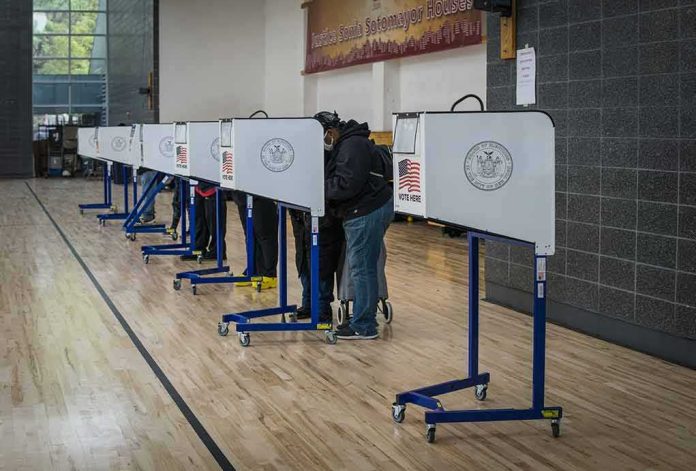
Virginia’s actual law supports Karl’s correction. State code says poll workers must ask each in-person voter for identification, but the list includes many non-photo options such as a voter confirmation document, a current utility bill, a bank statement, a government check, a paycheck, or other government papers showing the voter’s name and address. The Virginia Department of Elections further explains that anyone who arrives without acceptable ID can sign an ID Confirmation Statement under penalty of felony and then cast a normal ballot. Voters who neither show ID nor sign the statement are still allowed to vote provisionally and can later provide ID or a signed statement so that ballot is counted. All of this means photo ID is not strictly required, even though identification of some kind — or a sworn statement — is part of the process.
Mixed Messages From the State Fuel Confusion
What makes this episode more troubling is that Virginia’s own materials help create the confusion Warner walked into. A 2025 “Voter Identification Chart” tells voters that “all voters casting a ballot in-person will be asked to show one form of identification,” and then lists IDs that include both photo documents and non-photo items like utility bills and bank statements, blurring the line between “ID required” and “photo ID required.” A separate state brochure, titled “YOUR PHOTO ID. YOUR VOTE. YOUR VOICE,” uses bold language saying “Virginia law now requires all voters to show acceptable photo ID at the polls,” language that dates back to the earlier strict photo ID law and does not match the current statute. Internal training materials for election workers still say “Virginia law requires all voters to show an acceptable form of ID at the polls,” while quietly noting that voters without ID may sign an ID Confirmation Statement and vote normally. These mixed signals let politicians cherry-pick phrases that fit their talking points, while ordinary voters are left wondering what is really required.
This problem is not unique to Virginia, but the Warner incident gives it a face. Researchers have noted for years that voter identification rules are often strict on paper, then softened in practice by affidavit options or broad lists of acceptable documents. In Virginia’s case, a strict photo ID regime took effect in 2014, backed by free state-issued photo voter cards and upheld by federal courts against claims it would disenfranchise minority and young voters. That photo-only law was later changed; summaries of the 2020 reforms explain that the state “rescinded the photo identification requirement” and replaced it with a more flexible non-photo ID approach. Yet brochures and training guides that still talk like photo ID is the rule remain in circulation, blurring the timeline for anyone who has not followed every legislative tweak. When a sitting senator cites those older-style materials to defend his party’s stance, it feeds the belief on both left and right that leaders are either careless with facts or using outdated information to sell a story.
Election Integrity, the SAVE Act, and Public Distrust
The timing of Warner’s misstatement matters because it came as he argued against Trump’s SAVE America Act, a national proposal that would tighten voter ID and citizenship checks and is popular with many conservatives who think past elections were vulnerable to fraud. Trump has said that voter ID is “the only way to ensure election integrity,” and many of his supporters see state-level flexibility, like Virginia’s affidavit option, as proof the system is too easy to game. On the other side, voting-rights groups and many liberals argue that strict photo ID rules hit poor, older, and minority citizens hardest, and that allowing utility bills or sworn statements protects the right to vote without clear evidence of widespread fraud. Warner’s error, caught instantly on air, plays directly into the frustrations of both camps: conservatives feel confirmed that Democrats are not honest about what laws really do, while liberals worry that messy communication and partisan attacks further weaken trust in elections.
Jonathan Karl challenges Mark Warner over Virginia voter ID requirementshttps://t.co/KlBXo4B3Gv
— Joey Jackson (@joeyj0937) July 20, 2026
For many Americans, this debate is less about Mark Warner personally and more about a system that seems designed to confuse. Voters hear one thing from politicians, another from network anchors, and yet another from official documents that do not agree with each other. People who already suspect a “deep state” or elite class looking out for itself see this as more proof that the rules are written in fine print and then spun differently on TV depending on who is talking. At the same time, the legal reality in Virginia shows how hard it is to strike a balance: the law tries to secure elections by asking for ID, but it also tries not to block those without photo documents by allowing non-photo papers and sworn statements. That may be a reasonable compromise on paper, yet without clear, honest messaging from state officials and national leaders, every televised slip becomes another spark in an already raging fire of mistrust surrounding the American vote.
Sources:
townhall.com, yesjamescitycountyva.com, elections.virginia.gov, register.dls.virginia.gov, dlcv.org, charlottesville.org, ballotpedia.org, troutman.com, vadogwood.com, responsivegov.org, electionlab.mit.edu