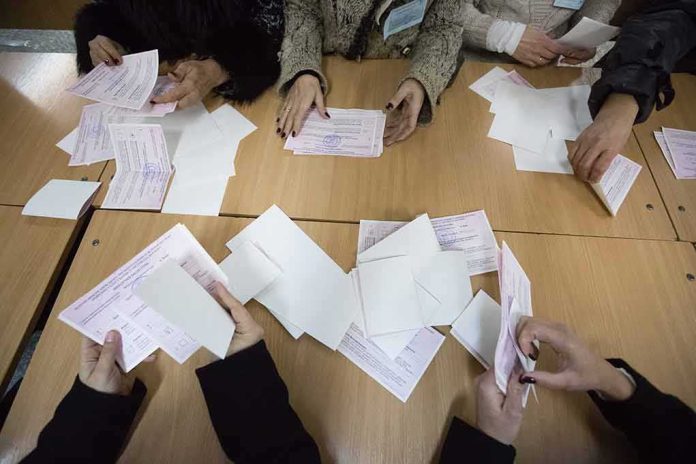
A California jury just delivered one of the starkest reminders in recent memory that election-fraud prosecutions, however rare in the aggregate, are not abstractions when local officials decide to bring one — a defendant who ran for mayor of a small coastal city stood trial for ten days, represented herself, and was convicted on every single count a prosecutor charged.
Key Points
- A San Luis Obispo County jury convicted Gaea Edde Powell on all nine counts related to the 2022 and 2024 Arroyo Grande mayoral election cycles.
- Charges included voter registration fraud, perjury by declaration, filing false nomination papers, failing to disclose under the Political Reform Act, and fraudulent voting in three separate elections.
- Prosecutors argued Powell falsely claimed residency at a James Way condominium in Arroyo Grande while actually living outside city limits.
- Powell represented herself at trial and has maintained publicly that she did not knowingly deceive anyone or act with fraudulent intent.
- Election-fraud convictions of any kind remain statistically rare nationwide, which is precisely why an individual case like this draws outsized attention.
The Verdict and the Charges
The San Luis Obispo County District Attorney’s office announced that a jury convicted Powell, born December 2, 1962, on all nine counts charged against her after a ten-day trial that concluded September 21, 2026. The counts spanned eight felonies and one misdemeanor and covered conduct the prosecution tied to specific dates: July 12, 2022; July 18, 2022; August 8, 2022; October 10, 2022; November 8, 2022; March 5, 2024; July 16, 2024; August 1, 2024; and November 5, 2024. The charges themselves were not a single offense repeated nine times but a cluster of distinct legal violations — registration fraud, perjury by declaration, filing false nomination papers, failing to provide written notice under California’s Political Reform Act, and fraudulent voting across three separate elections.
That breadth matters. A conviction on one count might reflect a paperwork lapse or an ambiguous filing; a conviction on nine, spanning two election cycles two years apart, reflects a jury’s judgment that a pattern existed and that it was knowing rather than accidental. Local outlets covering the trial, including KSBY and KEYT, reported the same charge structure and the same verdict date, reinforcing that the county’s account of what happened is not in dispute.
https://www.youtube.com/watch?v=NZ_vKoJmapc
How the Case Was Built: Residency as the Legal Fault Line
Election law rarely turns on abstractions; it turns on addresses. Candidacy for a city office like mayor of Arroyo Grande requires a candidate to actually reside within the jurisdiction they seek to represent, and voter registration carries the same requirement. Reporting from the San Luis Obispo Tribune describes the prosecution’s theory as centered on Powell’s claim to live at a condominium on James Way in Arroyo Grande when she in fact lived outside city limits. That distinction — claimed residence versus actual residence — is the legal hinge on which registration fraud, false nomination papers, and fraudulent voting charges all turn, because each of those acts requires the person to represent, under penalty of perjury, that they meet a residency threshold they may not have met.
This is not a novel legal theory nationally. Courts in other jurisdictions have wrestled with nearly identical fact patterns — a New York judge, for instance, ruled in 2024 that using a friend’s address for voting and political purposes without genuinely living there did not satisfy state residency law, warning that a looser standard would invite exactly this kind of “fraud and political mischief” the election code was designed to prevent. The Powell case follows that same logic: prosecutors did not need to prove she lied about who she was, only that she misrepresented where she lived, repeatedly and across multiple official filings, over a two-year span.
Powell’s Defense and the Pro Se Trial
Powell represented herself throughout the proceeding, a fact the Tribune noted when reporting the jury’s guilty finding. Self-representation in a felony trial is a demanding undertaking under any circumstances, and it makes the unanimous, all-counts verdict more, not less, notable — the prosecution secured a complete conviction against a defendant arguing her own case rather than against a lawyer working to create reasonable doubt. Powell has consistently pushed back on the fraudulent-intent element central to several of the charges. She told reporters after the verdict, “I have maintained from the beginning, and I maintain today, that I did not knowingly deceive anyone and did not act with fraudulent intent”, and in earlier coverage she said she had maintained two residences, had followed guidance from local officials, and had emails with the city she believed showed she had done nothing illegal to the best of her knowledge.
Those statements are part of the public record of the case and are worth reporting alongside the verdict, because they represent Powell’s own account rather than speculation. The jury heard that defense over ten days of testimony and rejected it on every count. A guilty verdict does not require the defendant to concede intent; it requires the state to prove it beyond a reasonable doubt to twelve jurors, which is exactly what happened here.
🚨🚨 BREAKING NEWS 🚨🚨
ANOTHER ELECTION FRAUD CONVICTION IN CALIFORNIA.
Former Arroyo Grande mayoral candidate Gaea Powell has been convicted on NINE election-related counts — eight felonies and one misdemeanor — including fraudulent voting in three separate elections.
And… pic.twitter.com/wMTcSn5bnE
— Mike Netter (@nettermike) September 23, 2026
Why a Case Like This Stands Out
Election-fraud prosecutions of any kind are uncommon relative to the volume of ballots cast in the United States. Research compiled by nonpartisan academic and legal analysts consistently finds documented instances of illegal voting are exceedingly rare, with incident rates estimated in fractions of a percent of total votes cast, and with the small number of prosecutions that do occur concentrated in cases — like this one — involving a specific, provable falsehood such as a residency claim rather than mass or coordinated fraud. That statistical rarity is precisely why a fully litigated, jury-tried, nine-count conviction in a small city like Arroyo Grande carries weight beyond its local scope: it is not a routine administrative correction but the culmination of a criminal justice process willing to devote a ten-day trial to a single candidate’s residency claims across two election cycles.
Sources:
feedpress.me, calcoastnews.com, ksby.com, sanluisobispo.com, x.com, yahoo.com, slocounty.ca.gov, ground.news