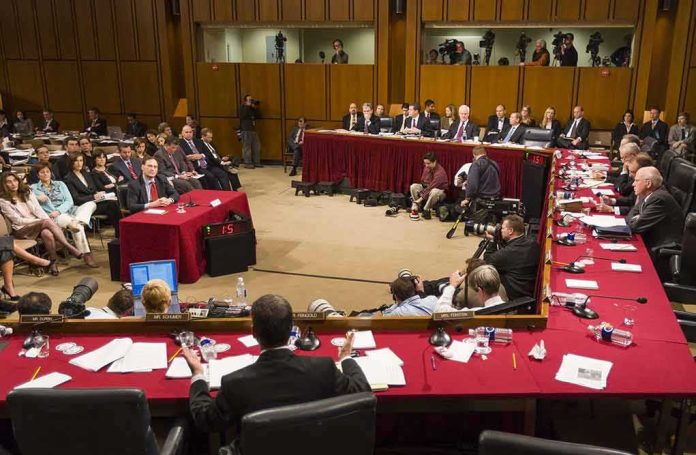
Jack Smith admitted judges were not told lawmakers’ phone records were swept into secret subpoenas, raising fresh constitutional alarms.
Story Highlights
- Smith said he sought non-content toll records to map Trump-era calls, citing incomplete White House logs.
- Unsealed materials and Senate oversight say the court was not told members of Congress were affected.
- Republicans argue secrecy orders blocked notice and Speech or Debate Clause claims.
- National Archives materials tied to 87 White House phones captured wider communications.
What Smith Told Senators About The Phone Record Subpoenas
ABC News and CBS report that Jack Smith told senators he sought non-content toll records to rebuild call patterns because White House switchboard logs were incomplete during the certification period. He said the selection was not about party, stating that if President Trump had called Democrats, their toll records would also be sought. He distinguished lawmakers’ toll records from any content of messages, telling senators he did not seek text content from members of Congress.
Associated Press coverage of a telecom-focused hearing records Smith’s statement that the criteria followed Trump’s call targets, not party identity. That detail matters because it frames the scope as event-driven. Yet even with that explanation, the approach still swept in call data touching lawmakers. Smith’s testimony left some technical gaps, including uncertainty over whether any geolocation data rode along with carrier returns, which Republicans highlighted as a tailoring concern.
The Secrecy Fight: What Judges Knew, And What They Did Not
The Senate Judiciary Committee publicized materials saying prosecutors did not tell the court that the subpoenaed accounts belonged to members of Congress when seeking nondisclosure orders. The New York Times reported a judge later unsealed filings that likewise showed the court was not told about congressional status on those accounts. That omission fuels the central dispute: whether secrecy orders were properly justified and whether the court had the facts needed to weigh constitutional protections.
Republican oversight documents further argue the nondisclosure orders blocked carriers from notifying affected lawmakers, short-circuiting any chance to assert Speech or Debate Clause protections before production. Senators Ted Cruz, Josh Hawley, and others say that failure goes to the heart of legislative independence. They contend the orders kept Congress in the dark while prosecutors pulled sensitive records, which they cast as an avoidable and serious breach of constitutional norms.
White House Devices, Archives, And The Scope Question
Fox News reported that records were produced by the National Archives in response to a June 2023 subpoena seeking material tied to 87 White House phones from President Trump’s first term. That Archives pathway is distinct from carrier toll-record subpoenas for lawmakers, but the mix of channels has sown public confusion. Critics argue that when records from government devices and carrier data move in parallel, the sweep can reach communications with lawmakers and reporters, even if content was not the target.
CNN’s live coverage stressed that two separate subpoenas are being confused in public debate: one aimed at lawmakers’ toll records, the other at White House staff records via the Archives. Smith’s team and defenders say both sets were used to reconstruct who called whom and when during a time of intense political pressure. But the fragmented disclosures and sealed filings have left gaps, allowing charges of a “dragnet” to take hold despite Smith’s claims of narrow, non-content targeting.
Constitutional Stakes: Speech Or Debate And Public Trust
Republicans on the oversight panels argue that lawmakers’ call logs can reveal the fact and timing of legislative discussions, which they say fall under the Speech or Debate Clause’s shield against compelled disclosure. They add that secrecy blocks timely privilege claims and undermines checks and balances. Smith answers that toll records are standard tools in federal probes and that he would have treated Democrats the same if Trump had called them, pointing to content neutrality rather than viewpoint targeting.
Jack Smith went digging through the phone records of the woman running Trump's campaign. Flip it. Trump's DOJ does that to Kamala's campaign chief and CNN runs it 24/7 for a year. Jordan is right. Prosecute. Equal justice or no justice.
— 仲間義道 (@evodiotovar) October 6, 2026
Here is the bottom line for readers who value limited government and the Constitution. The record shows Smith pursued toll records to fill gaps in official logs, but judges were not told that members of Congress were involved when secrecy orders were sought. That silence is not a small thing. It touches the core of legislative independence. Until full applications and transcripts are released, distrust will grow, and the system’s promise of transparent justice will take another hit.
Sources:
redstate.com, foxnews.com, ntd.com, judiciary.house.gov, cnn.com, cbsnews.com, judiciary.senate.gov, reuters.com