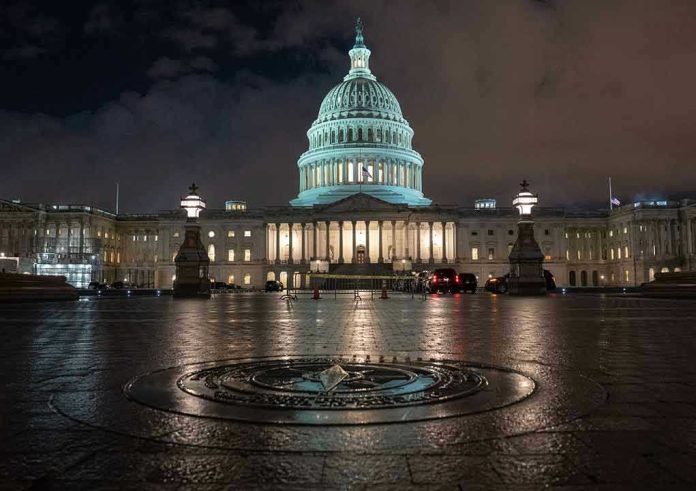
A $70 billion immigration enforcement bill just roared through the Senate after an all-night battle—funding Immigration and Customs Enforcement and Border Patrol for the rest of Trump’s term while leaving a controversial $1.8 billion “anti-weaponization” fund untouched.[1][2][3]
Story Snapshot
- The Senate narrowly passed a $70 billion package to fund Immigration and Customs Enforcement and Border Patrol for three years, covering the remainder of President Trump’s second term.[2][3][4]
- Lawmakers endured an 18‑ to 20‑hour marathon of amendment votes, but every attempt to rein in the administration’s $1.8 billion settlement “anti-weaponization” fund failed.[1][2][3]
- The bill moves roughly $38.5 billion to Immigration and Customs Enforcement and over $26 billion to Customs and Border Protection, a major expansion of front-line enforcement capacity.[4]
- Only one Republican senator, Lisa Murkowski, joined Democrats in opposing the bill, exposing internal GOP tension over the settlement fund even as the party backed enforcement funding.[1]
What Exactly Did the Senate Just Pass?
The United States Senate approved a roughly $70 billion immigration enforcement bill on a 52–47 vote, with all Democrats and one Republican, Senator Lisa Murkowski of Alaska, opposed.[1][3] The package funnels funding to President Trump’s immigration enforcement agencies for the next three years, meaning Congress would not have to revisit core funding for Immigration and Customs Enforcement and Border Patrol again during the remainder of his current term.[2][3] Supporters cast this as locking in stability at the border after years of stop‑and‑go fights.[2][3]
Reporting indicates that the legislation’s internal breakdown directs about $38.5 billion to Immigration and Customs Enforcement and more than $26 billion to Customs and Border Protection, with additional funds rounding out the total.[4] Those line items go toward detention capacity, personnel, and operations that backstop immigration arrests and border security, not toward new social programs.[2][3][4] For conservatives who have watched waves of illegal crossings and overwhelmed agents for years, this scale of funding represents a long‑sought attempt to regain operational control.[3]
The All‑Night Vote and the Fight Over Trump’s Settlement Fund
The bill only passed after an all‑night “vote‑a‑rama” that stretched roughly 18 to nearly 20 hours, as senators from both parties tried to rewrite parts of the package through amendments.[1][2][3] The fiercest fight centered on the administration’s planned $1.8 billion settlement “anti‑weaponization” fund at the Department of Justice, created as part of a deal tied to President Trump dropping a lawsuit against the Internal Revenue Service.[1] Democrats and some Republicans argued the fund looked like a political slush fund for allies claiming persecution by the government.[1][2][3]
During the marathon session, senators offered repeated amendments aimed at blocking, limiting, or redirecting that settlement fund, but every single one failed.[1][2][3] Proposals ranged from banning the fund outright to redirecting money to law enforcement injured on January 6 or to fraud enforcement, each drawing some crossover Republican support but not enough votes to pass.[2][3] In the end, the Senate sent the immigration bill to the House without any language that would restrict or permanently end the “anti‑weaponization” fund, even after the acting attorney general announced plans to scrap it under public pressure.[1][2][3]
Conservative Gains on Enforcement, Lingering Worries on Accountability
For Trump‑supporting readers who have demanded Washington finally get serious about the border, this vote marks a major institutional shift.[2][3] Congress had previously funded most of the Department of Homeland Security while leaving immigration enforcement unresolved after a shutdown fight, but Republican lawmakers used a budget mechanism called reconciliation to push this separate package through.[3][4] The result is three full years of guaranteed resources for Immigration and Customs Enforcement and Border Patrol, insulating enforcement from annual brinkmanship and giving the Trump administration the tools it said it needed.[2][3][4]
At the same time, the way the Senate handled the settlement fund raises classic concerns about government overreach and political favoritism that many conservatives share.[1][2] Even though several Republican senators voiced deep reservations and backed amendments to clip or repurpose the fund, party leaders ultimately held the line against anything that might be seen as undercutting President Trump’s negotiation, prioritizing passage of the enforcement bill.[1][2][3] That choice leaves no statutory guardrail in this bill itself to prevent a future Justice Department from repackaging similar funds under a different name.[1]
Why This Fight Matters for the Constitution and Future Border Policy
This funding battle fits a familiar pattern where immigration budgets double as proxy wars over executive power and constitutional limits. Supporters argue that long‑term appropriations through 2029 and beyond are needed so front‑line agents can plan staffing, detention, and operations without wondering whether activists in Congress will pull the plug.[4] Opponents, including immigration‑advocacy groups, counter that such large sums risk entrenching an enforcement‑first model without enough transparency, accountability, or protection of due‑process rights at the border.
Senate passes $70b immigration enforcement bill https://t.co/J1h08eWi65 via @BostonGlobe
Are you happy to see $70 billion of our tax dollars spent to round up and deport people (or send them to one of the for-profit prison that's making Trump's political donors rich)? I'm not.
— Janice Blake (@JanzaBlake) June 6, 2026
The existing reporting does not yet show detailed language on child‑trafficking enforcement, interagency coordination, or rigorous oversight requirements inside the bill text itself.[1][2][3] Analysts note that while the funding levels are undeniably large, there is still no public cost‑benefit analysis demonstrating how many more removals, shorter processing times, or dismantled trafficking networks will result.[4] For conservatives who want both a secure border and a government that respects limits, the next key step will be pressing Congress and the agencies to prove this money is used to enforce the law—not to expand bureaucratic power behind closed doors.
The Senate just passed a massive $70 BILLION immigration enforcement bill in a chaotic middle-of-the-night vote.
Virtually zero guardrails. This completely greenlights Trump’s mass deportation agenda for the next three years.
It’s about to get real.— Watching Trending (@WT_Trending) June 6, 2026
Sources:
[1] YouTube – Senate Passes $70B Immigration Enforcement Bill After Marathon Vote
[2] Web – Senate passes bill to fund ICE for 3 years, without ban on DOJ …
[3] Web – Senate approves $70 billion immigration enforcement bill – ABC News
[4] YouTube – Senate passes $70B immigration enforcement bill funding ICE and …