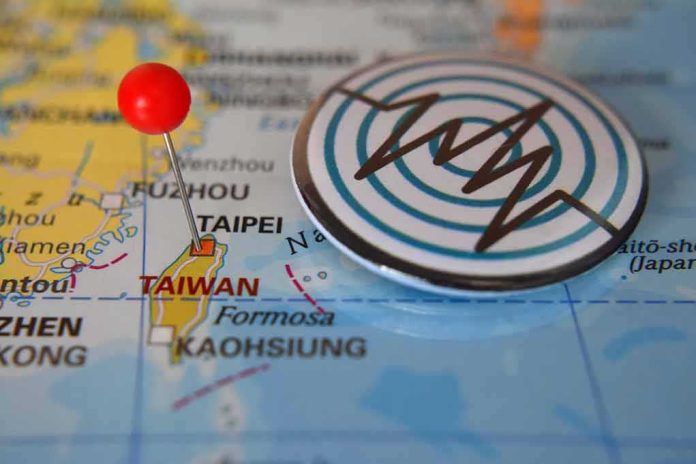
Taiwan’s president says he is “happy” to speak with President Trump as Beijing fumes, putting America’s deterrence and diplomacy squarely back in the driver’s seat.
Story Highlights
- Taiwan’s President Lai Ching-te signaled openness to a direct call with President Trump, elevating deterrence messaging amid rising tensions [8].
- President Trump said he is preparing to speak with Lai while weighing major U.S. arms sales to Taiwan [1].
- Any leader-to-leader contact is rare and highly symbolic given four decades of carefully managed U.S.–Taiwan ambiguity [3].
- China warned against steps implying Taiwan’s separate status, underscoring the stakes of Washington’s decisions [5].
Lai’s Invitation Meets Trump’s Willingness To Engage
Taiwan’s Ministry of Foreign Affairs said President Lai Ching-te is open to speaking directly with President Donald Trump, a move that would mark a rare and pointed signal of coordination against coercion in the Taiwan Strait [8]. Politico reported President Trump said he is preparing to speak with Lai as part of his decision process on potential arms sales to Taiwan, tying direct diplomacy to concrete defense outcomes [1]. The pairing of outreach and capability signals a strategy of deterrence through strength.
Direct leader-level communication between Washington and Taipei has been uncommon since the United States shifted diplomatic recognition to Beijing in 1979, making even the possibility of a call a consequential event in its own right [3]. Trump’s openness to discuss Taiwan security with Lai, aligned with ongoing arms-sale considerations, suggests the administration is integrating messaging, policy, and procurement to stabilize the status quo through credible defense planning [1]. That approach plainly communicates that peace is preserved by readiness, not by wishful thinking.
Why A Call Matters: Deterrence, Signals, And The Stakes
Since 1979, U.S. policy has balanced strategic ambiguity with material support to Taiwan, creating guardrails that deter aggression without formal diplomatic recognition [3]. When an American president entertains direct talks with Taiwan’s leader, the signal can amplify deterrence by showing unity of purpose while decisions on arms transfers are weighed [1]. Supporters argue pairing dialogue with defense commitments reduces miscalculation by demonstrating that coercion will be met with strengthened capabilities, not retreat or mixed messages.
The prospective call lands amid reports and commentary underscoring how contacts at this level reverberate far beyond a single policy step [4]. Analysts have long noted that cross-strait stability is sensitive to signals from Washington, Taipei, and Beijing, and that perceived slippage in resolve can invite adventurism [3][4]. In that light, Taipei’s public readiness to speak and Washington’s consideration of robust arms packages are read together as a coherent message: the United States will help friends defend themselves to keep the peace [1][8].
Beijing’s Pushback And The Risks Of Miscalculation
Chinese statements and coverage have framed Taiwan as Beijing’s “most important issue” with the United States, warning that mishandling it could become “very dangerous,” and rejecting Taiwan independence outright [5]. Those warnings accompany objections to any leader-to-leader contacts that could imply state-to-state normalization. Such rhetoric aims to chill engagement and narrow Taiwan’s diplomatic space, but it also raises the risk that restraint is misread as weakness, a dynamic deterrence is designed to counter.
✅
🚨 BREAKING: Taiwan says President Lai is open to talks with Donald Trump
— Taiwan said President Lai Ching-te would be willing to speak with Donald Trump, signaling possible future dialogue as tensions between China, Taiwan, and the United States continue to shape regional…— THE TRUT NEWS HUB (@mr_eon) May 21, 2026
Historical context shows why this matters. The 2016 call between then President-elect Trump and Taiwan’s President Tsai Ing-wen was brief yet historic, highlighting how even limited direct contact can reshape expectations and signal a tougher American line on Indo-Pacific security [3]. Today’s scenario is different in one key respect: the Trump administration is already in office and actively tying dialogue to defense decisions. That linkage converts symbolism into leverage, aligning words with weighty policy tools [1][3].
What This Means For U.S. Policy And Conservative Priorities
Conservative principles favor peace through strength, free nations choosing their own path, and firm resistance to authoritarian bullying. A potential Trump–Lai call, anchored to arms decisions, reflects those principles by coupling diplomacy with hard power [1][8]. Supporters view this as a reset from years when globalist caution too often meant paralysis. By contrast, clear commitments, secure supply lines, and credible capabilities deter conflict, protect trade routes, and avoid costlier wars that drain American families and budgets.
Policy limits still apply. The United States has not recognized Taiwan diplomatically since 1979, and Washington continues to manage its “one China” framework while supplying Taiwan with defensive means [3]. Within that structure, timely communications and well-structured arms packages can raise the costs of coercion without abandoning long-standing commitments. The practical test now is execution: pairing the right capabilities with steady messaging that denies Beijing opportunities for salami-slice gains or propaganda wins [1][5].
The Road Ahead: Capabilities, Clarity, And Credibility
Next steps likely hinge on three factors. First, whether a Trump–Lai call is completed and framed as a deterrence-oriented coordination, not provocation. Second, whether arms decisions prioritize asymmetric defense systems, training, and sustainment that harden Taiwan’s defenses efficiently [1]. Third, whether the administration keeps communications disciplined as Beijing protests, ensuring that every public line strengthens, rather than blurs, America’s red lines and commitments under existing law and policy [5].
For readers concerned about national strength, constitutional clarity in war powers, and responsible spending, the calculus is straightforward: decisive diplomacy backed by the right tools is cheaper than conflict and firmer than appeasement. If Lai and Trump speak, and if that talk is matched with targeted defensive support, Washington can reduce risk, reassure allies, and remind Beijing that America stands with free peoples who choose their leaders and defend their homes [1][8].
Sources:
[1] Web – Trump says he’ll talk to Taiwan’s president amid arms deal … – …
[3] Web – Trump–Tsai phone call – Wikipedia
[4] Web – Media Briefing: Making Sense of the Trump-Xi Summit
[5] YouTube – China’s warning to Trump on Taiwan | ABC News Daily podcast
[8] Web – Taiwan Says Lai Ready To Speak Directly With Trump