When violence erupts in an everyday place—a seasonal store in a suburban mall—the facts that matter most come first: seven people were shot, one died, and police say the gunman had not been identified as investigators began the urgent, methodical work of reconstructing what happened and who is responsible.
At a Glance
- Police reported seven gunshot victims at the Spirit Halloween inside Solano Town Center around 8:30 p.m.; one person died and six were hospitalized.
- At least three of the wounded were in critical condition, according to Fairfield Police Chief Dan Marshall.
- No suspect had been identified as detectives reviewed surveillance video and interviewed witnesses.
- Authorities emphasized an active investigation and asked the public to share any relevant footage or information.
What Police Reported: The Core Facts
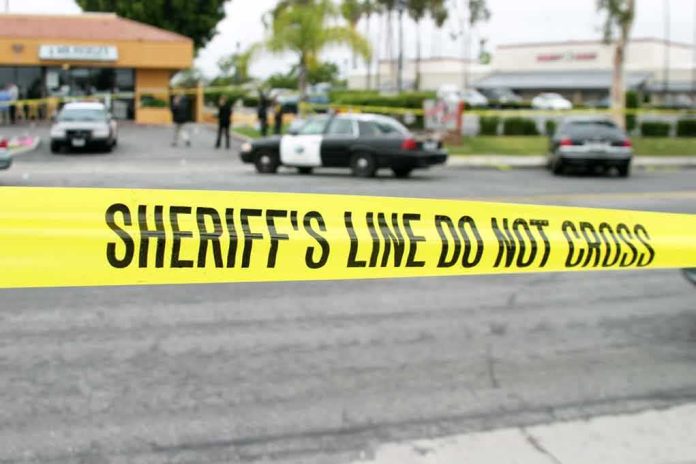
Fairfield police said officers responded at approximately 8:30 p.m. to reports of gunfire inside the Spirit Halloween store at Solano Town Center. On arrival, they found seven people with gunshot wounds. One victim was pronounced dead; six were transported to area hospitals. At least three of those wounded were in critical condition, Chief Dan Marshall told reporters. He added that detectives were combing mall surveillance footage and interviewing witnesses to identify the shooter or shooters, but no one was in custody and no description had been released at that time.
The early perimeter and active crime-scene designation remained in place as investigators worked to verify whether the gunfire was confined to the store or extended elsewhere in the mall; that question, police indicated, would be answered through video review, physical evidence, and additional witness accounts.
How These Investigations Actually Unfold
In a public-place shooting, the first hours are a race to triage victims and stabilize the scene while preserving evidence. Patrol officers secure entry and exit points and establish a single command post; detectives then build a timeline by synchronizing 911 call logs, computer-aided dispatch times, and officers’ body-worn camera timecodes. Surveillance video—in malls, a patchwork of cameras owned by the property, tenants, and sometimes kiosks—provides the backbone of a movement map: where the gunfire began, how many shooters there were, and the direction of flight. Shell-casing locations, bullet strikes, and recovered projectiles are plotted to estimate lines of fire and weapon types; that physical map is then cross-checked against witness statements to identify consistencies and discard inevitable noise.
Medical outcomes evolve. A headline that compresses casualties into “one dead, six injured” risks sounding static, but trauma care is dynamic; critical patients may improve or worsen over hours. This is why police chiefs typically anchor to the count at the time of briefing and avoid premature updates. The coroner’s office later provides the legal identification and cause of death; hospitals, bound by privacy rules, rarely add detail beyond condition status.
Why This Incident Drew Immediate, National Attention
Gun violence research repeatedly documents that public settings with multiple victims trigger disproportionate coverage relative to overall incidence: a mall during Halloween season is the archetype of a high-salience location. Empirical studies have found that victim counts and conspicuous venues—schools, houses of worship, government buildings, and large retail spaces—predict outsized media attention; mall shootings, specifically, are more likely to be covered than comparable incidents in less emblematic spaces. That amplification produces a paradox: a preliminary police-sourced snapshot becomes the national narrative while critical questions—motive, relationships among parties, and precise scene boundaries—are still being answered.
Understanding that pattern helps calibrate consumption. The most reliable early facts tend to be countable (victims, time, place) and directly observable by first responders. The more inferential claims—motive, affiliations, precipitating disputes—belong to the middle and later phases of an investigation, when phone records, ballistic matches, and corroborated witness testimony have been layered onto the scene map.
Where Uncertainty Properly Lives—and How It’s Resolved
In Fairfield, police were unequivocal about the casualty count and the location focus. They were appropriately cautious about motive, suspect identity, and whether all gunfire occurred inside the store. Those open questions narrow through a familiar sequence: canvas and collect all camera feeds on synchronized time; recover casings and submit them to NIBIN, the national ballistics network; interview witnesses multiple times as memory stabilizes; and, if a firearm is recovered, test-fire to confirm matches to scene evidence. If arrests follow, charging documents, warrant returns, and preliminary-hearing testimony typically supply the first public, granular reconstruction.
When the shooter is not immediately identified, police widen the aperture: review social media tips, check recent disputes linked to the location or victims, and query regional license plate readers for vehicles leaving the scene within the relevant window. Whether the public colloquially calls this a “manhunt” or an “active search,” the operational reality is the same—detectives and task force partners follow leads while patrol units handle visible presence and targeted canvassing.
Community Risk and Reassurance
After high-profile public shootings, communities ask two practical questions. First: is there a continuing threat? Police in Fairfield signaled they did not believe there was an immediate, ongoing danger beyond the active investigation, even as they kept the scene controlled for evidence processing—a common balance point in similar cases. Second: what can residents do that is actually helpful? The answer is unglamorous and effective—share unedited video from the relevant time window, report overheard statements about the event, and provide even small details that can anchor a timeline. In surveillance-rich environments like malls, a handful of clean angles and precise timestamps can make or break suspect identification.
For retailers and property managers, post-incident posture often includes reviewing entry and exit access, camera placement and retention policies, and coordination protocols with local police. Preventive architecture—clear sightlines, reliable recording at choke points, and functional alarms—does not eliminate risk, but it shortens investigative cycles and, in some cases, deters opportunistic violence.
BREAKING NEWS UPDATE: The person killed in a shooting Friday night inside a Spirit Halloween store in Solano Town Center in Fairfield was a 31-year-old pregnant woman, family members said.
Story here: https://t.co/7iPYkYMwPh pic.twitter.com/ufbhHaEdKZ
— ABC7 News (@abc7newsbayarea) October 31, 2026
The Bottom Line
The Fairfield shooting is a case study in how credible, preliminary facts coexist with unanswered investigative questions. The police account was clear on the essentials—seven shot, one killed; the scene centered on Spirit Halloween at Solano Town Center around 8:30 p.m.; three victims in critical condition; suspect not yet identified—and that is the backbone of any careful understanding of the event. The rest unfolds through established investigative craft. As the record matures—from surveillance pulls to ballistics to potential charges—the picture will sharpen. Until then, the surest ground is the countable, the corroborated, and the on-record.
Sources:
thegatewaypundit.com, abcnews.com, weartv.com, newschannel10.com, nbclosangeles.com, wdam.com, courtlistener.com, ideas.repec.org, tandfonline.com