Courts are beginning to draw a constitutional line between blanket “sensitive place” gun bans and targeted, evidence-driven security at houses of worship; in Montgomery County, that line now lets a synagogue arm trained volunteers inside while leaving broader perimeter limits unresolved.
The Short Version
- A federal judge preliminarily blocked Montgomery County from enforcing its carry ban against a synagogue and its rabbi inside their sanctuary, finding a likely Second Amendment violation as applied to them.
- The ruling turned on the inadequacy of the county’s justifications compared with licensed security exemptions, not on a wholesale invalidation of the law; the 300-foot perimeter rule still stands for now.
- Orthodox practice—walking rather than driving on the Sabbath—makes a pedestrian buffer far more restrictive than a comparable driving exception, sharpening the free-exercise and self-defense clash.
- The case advances on appeal, where plaintiffs also challenge the pedestrian-distance rule under the Second Amendment and the Free Exercise Clause.
What the court actually decided—and what it did not
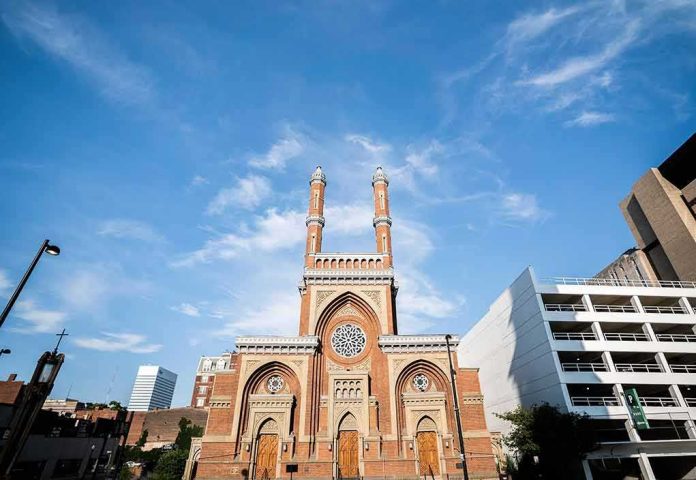
In September 2026, the U.S. District Court for the District of Maryland granted a targeted preliminary injunction to Silver Spring Jewish Center (SSJC) and Rabbi Shmuel Shapiro, barring Montgomery County from enforcing its firearms prohibition against them inside their place of worship. The court concluded the plaintiffs are likely to succeed on their as-applied Second Amendment claim, distinguishing between their trained volunteer security team and the county’s separate allowance for licensed security guards. In essence, the county had not shown that permitting SSJC’s vetted volunteers to carry inside was materially more dangerous than the already exempt, licensed alternative.
The relief is partial. The order did not strike down the county’s overall regime. It left intact the “place of public assembly” perimeter rule—set at 300 feet in reporting on this dispute—so congregants walking to synagogue remain bound by that buffer for now. The docket subsequently reflects an order denying a later motion (ECF No. 48), underscoring that the litigation remains dynamic and that not every requested form of relief has been granted.
How the county’s public-assembly rule works
Montgomery County’s modern approach is categorical and perimeter-based. The code prohibits selling, transferring, possessing, or transporting firearms and ammunition in or within 100 yards of places of public assembly; county amendments and public descriptions frame the list to include schools, parks, libraries, polling places, legislative assemblies, and houses of worship. The county also created a driving-through exemption while narrowing locations already covered by state law, an effort to harmonize overlap while maintaining broad buffers in dense civic spaces.
County officials defend this as a classic public-safety measure, rooted in Maryland’s state-law authorization permitting charter counties to regulate firearms in or within 100 yards of defined sensitive locations. The state’s high court recently affirmed that authorization’s scope, which Montgomery cites to validate its perimeter architecture around public-assembly venues. The county’s position is straightforward: fewer guns in crowded civic settings means fewer opportunities for violence, and where the state empowers local tailoring, Montgomery has tailored.
Why the synagogue prevailed—inside the sanctuary
Post-Bruen litigation turns on history rather than judge-weighed policy outcomes; governments must show modern restrictions fit within the nation’s historical tradition of firearm regulation. Houses of worship occupy an uneasy space in that framework. Some courts read them as akin to courthouses and polling places—core “sensitive” locations—while others find the historical record thin and inconsistent. In SSJC’s case, the district court was not asked to resolve the entire category for all time; it was asked whether, on this record, disarming trained volunteers inside this synagogue likely violates the Second Amendment. The court said yes, because the county’s comparators cut against it: if licensed guards may carry, the county needed a concrete reason to forbid similarly trained volunteers performing the same protective function. It did not supply one.
That reasoning is narrow but consequential. It signals that categorical “no carry” edicts can falter when real-world security practices—volunteer teams vetted and trained to protect a congregation—look indistinguishable from authorized alternatives. Put differently: line-drawing cannot rest on labels alone when roles, risk, and safeguards match.
The harder problem: walking to worship under a perimeter ban
The more stubborn conflict lies outside the sanctuary. Orthodox Jews typically do not drive on the Sabbath, so their routes to and from services are on foot. A perimeter rule, combined with a dense map of parks, schools, and other assemblies, can convert ordinary neighborhoods into continuous gun-free corridors. A driving-through exemption does not solve a walking problem. Plaintiffs argue that this interaction burdens both self-defense and religious exercise: it uniquely disables observant congregants from lawful transport on the very days and times their services occur.
That claim is now before the Fourth Circuit, alongside the Second Amendment challenge. On the free-exercise side, courts will ask whether the rule is neutral and generally applicable, and if so, whether plaintiffs can show selective burdens triggered by religious conduct. On the Second Amendment side, judges will probe historical analogues for perimeters around places of worship and other assemblies. The panel will also weigh whether the county’s driving exemption, but not a narrow walking exception for defined routes to services, is constitutionally coherent in a post-Bruen world focused on tradition and tailored fit.
Public-safety rationales and the limits of categorical zones
Montgomery’s rationale is not invented post hoc; it flows from a broader legislative project since 2022 to reduce firearms in crowded civic environments, and it sits on clear state-law footing for the categories the county retained. But Bruen’s test does not ask whether a legislature acted in good faith; it asks whether a particular modern burden aligns with the nation’s historical tradition. Sensitive places were recognized historically—courthouses and polling places foremost—but courts have split on whether that tradition supports expansive, contiguous perimeters or blanket categories that swallow ordinary travel.
That is why SSJC’s partial win matters methodologically. It shows courts willing to distinguish interior religious-security questions from surrounding buffers; to look past labels to practical comparators (licensed versus volunteer security); and to reserve judgment on rules that may impose unique, if unintended, burdens on religious practice. The preliminary posture does not predetermine the merits. It does, however, preview a doctrine that is granular rather than sweeping.
What to watch on appeal and beyond
First, the Fourth Circuit’s treatment of the walking-to-worship claim will signal how far perimeter logic can reach when it collides with routine religious observance. A narrow exemption accommodating defined pedestrian routes during fixed service windows would be administrable; the constitutional question is whether the Second Amendment or Free Exercise Clause demands something like it. Second, expect continued evidentiary pressure: governments will need historically grounded justifications and safety data that map onto the specific conduct restricted, while plaintiffs will be pressed to document concrete burdens with route maps, training records, and security protocols.
Bottom line
Montgomery County’s regime remains largely intact, but not unimpeachable. Inside one synagogue, trained volunteers may carry because the county failed to justify treating them differently from licensed guards. Outside, a still-operative perimeter collides with the realities of Sabbath observance and the modern Second Amendment. The durable lesson is not that sensitive-place laws are doomed; it is that they must be historically moored, precisely drawn, and workable for the people they bind.
Sources:
reason.com, supreme.justia.com, courtlistener.com, politomix.com, govinfo.gov, thebanner.com, apps.montgomerycountymd.gov, mocoshow.com